

If you are walking into a job interview having only skimmed the company’s “About Us” page, you are already at a massive disadvantage.
In today’s hyper-competitive job market, hiring managers are no longer just looking for qualified candidates; they are looking for candidates who understand their specific business problems. The days of sending a generic resume and winging the interview are over. To stand out, you need to prove that you are an insider before day one.
This is where the concept of “deep research” comes in, and it is the single biggest differentiator between candidates who get a polite rejection email and those who get the offer.
The Problem with Surface-Level Research
Most job seekers do the exact same pre-interview routine: they look at the company website, glance at the CEO’s LinkedIn profile, and maybe read one recent blog post.
This surface-level approach leads to generic interview answers. When asked, “Why do you want to work here?”, the candidate usually repeats a generic marketing tagline back to the hiring manager. It doesn’t show initiative, and more importantly, it doesn’t show how the candidate can solve the company’s current pain points.
What is True “Deep Research”?
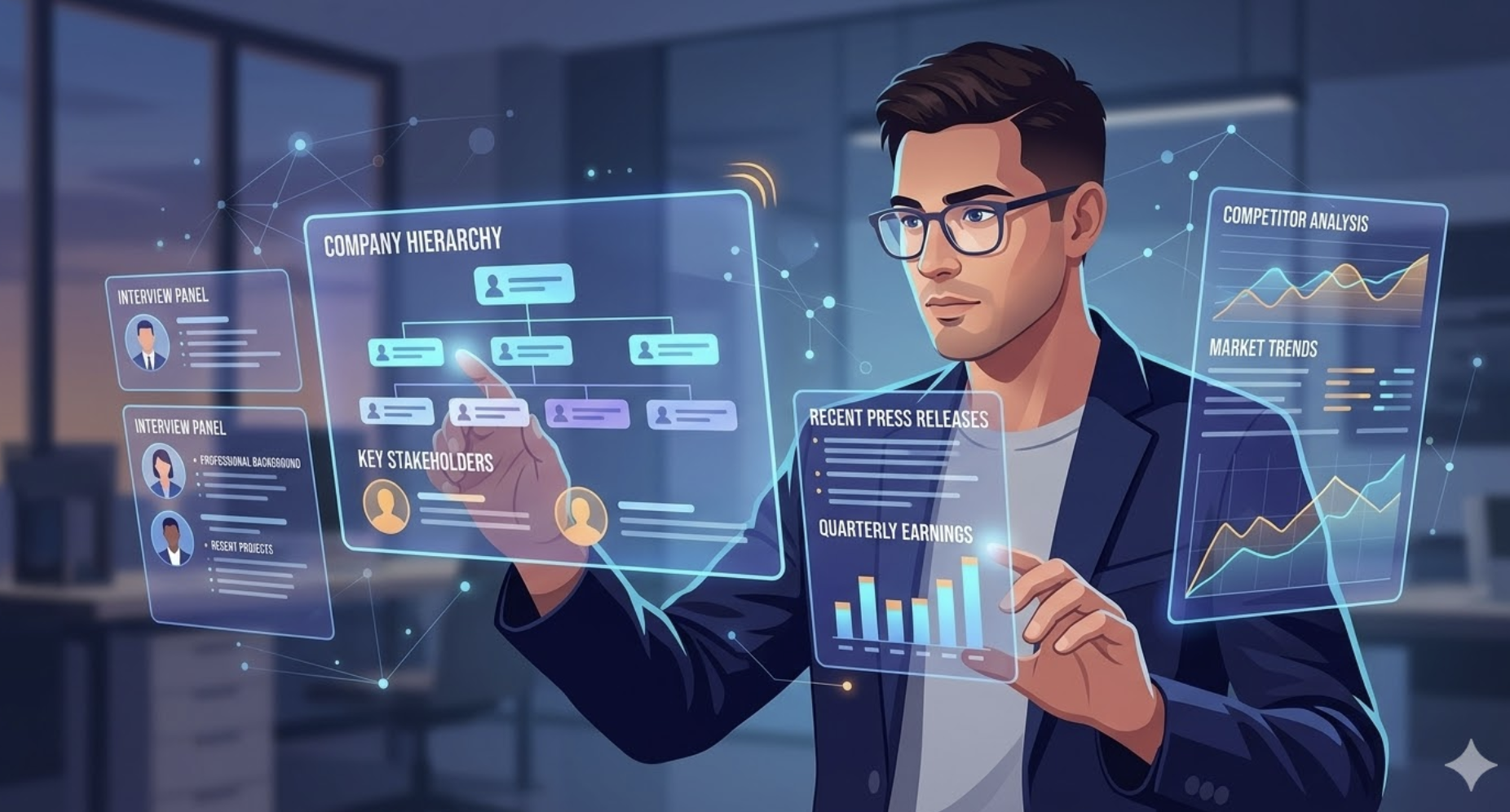
True deep research means auditing a company like an investor would. It involves analyzing:
- Recent financial earnings and market positioning: Are they expanding or cutting costs?
- Competitor analysis: Who is eating their market share, and how can your role help defend it?
- Interviewer backgrounds: What projects has your hiring manager been pushing on LinkedIn or GitHub?
- Tech stack and toolsets: What software do they use, and how quickly can you integrate into their workflow?
When you have this level of data, your interview transforms. You stop answering questions passively and start having high-level, strategic conversations about the company’s future.
The Time Bottleneck (And How to Bypass It)
The reason most candidates don’t do deep research is simple: it takes hours. Manually scraping through press releases, quarterly earnings reports, employee reviews, and social media feeds is exhausting, especially when you are juggling multiple job applications.
This is why top-tier professionals are now automating this process. By leveraging an AI deep research tool, you can instantly aggregate and analyze a company’s entire digital footprint in seconds.
Instead of spending four hours digging through Google pages to find a company’s strategic initiatives, the AI compiles a comprehensive, digestible dossier on the company, the culture, and your specific interviewers.
Personalize Your Pitch
When you use UniqU Deep Research, you enter the interview room armed with actionable intelligence. You can tailor your portfolio to highlight the exact skills the company is currently lacking. You can ask hyper-specific questions at the end of the interview that leave the hiring manager thinking, “This person gets exactly what we are trying to build.”
Don’t leave your career trajectory to chance or surface-level Google searches. Let the data do the heavy lifting, and walk into your next interview with an unfair advantage.
Frequently Asked Questions (FAQs)
What is deep research in a job search? Deep research in a job search goes beyond reading a company’s website. It involves analyzing their recent market performance, competitor strategies, tech stack, and the specific professional backgrounds of your interviewers to tailor your application and interview answers.
How much time should I spend researching a company before an interview? Traditionally, thorough company research can take 2 to 4 hours per interview. However, by using AI-driven research tools, candidates can instantly generate comprehensive company and interviewer dossiers, cutting preparation time down to minutes.
What are the most important things to research before a job interview? The most critical elements to research include the company’s recent challenges or product launches, the specific pain points of the department you are joining, the industry’s competitive landscape, and the professional history of your hiring manager.
