

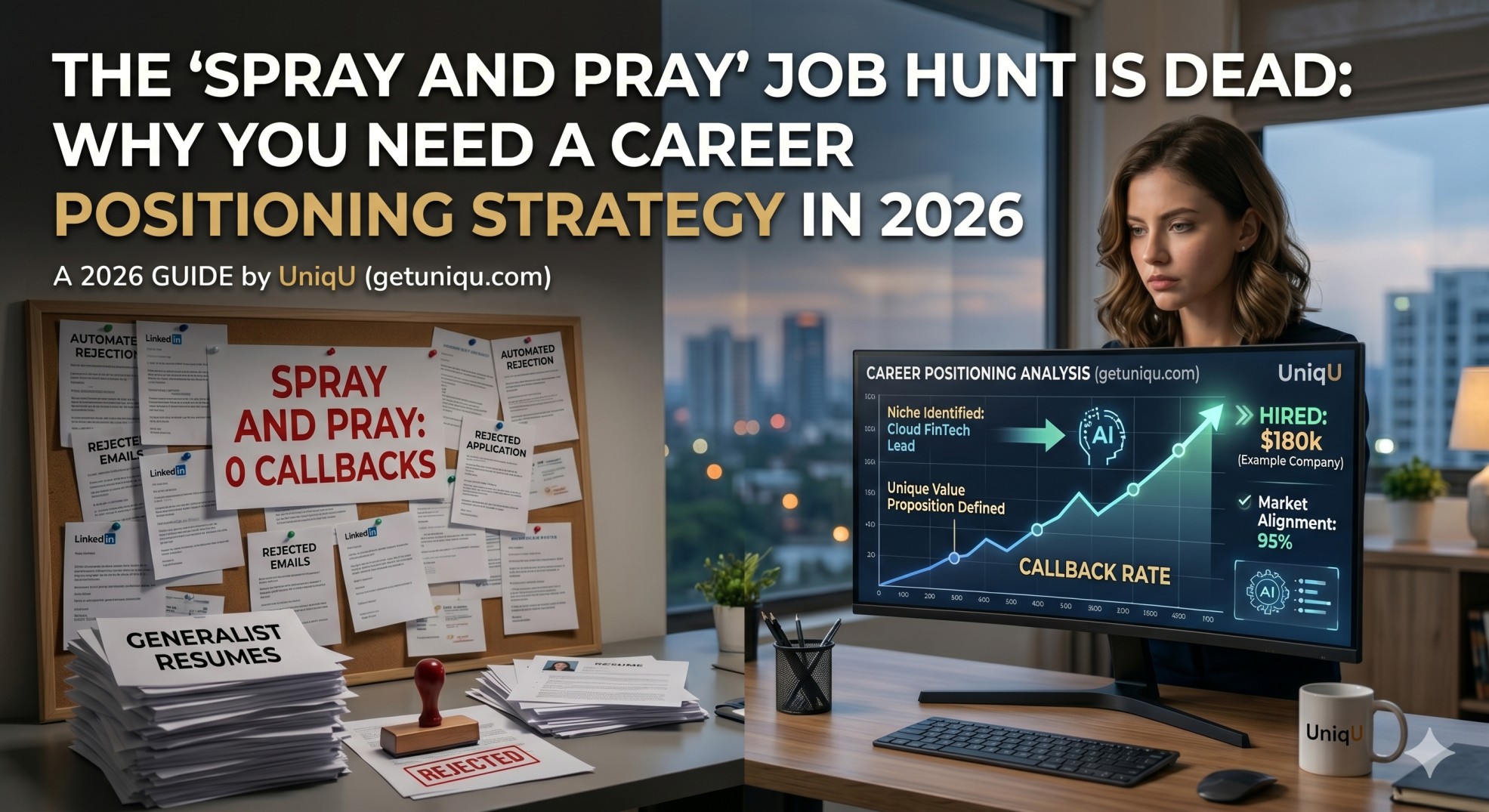
If your current job search strategy involves clicking “Easy Apply” on LinkedIn 100 times a day and hoping for the best, you are setting yourself up for failure.
In the 2026 talent market, the “spray and pray” method no longer works. With remote work globalizing the talent pool and AI agents auto-generating cover letters for every candidate, recruiters are drowning in thousands of identical applications. To cut through the noise, you can no longer afford to be a generalist. You must treat your career like a premium product, and every premium product requires a definitive Career Positioning Strategy.
Here is why relying on volume is destroying your callback rate, and how leveraging data-driven career positioning can make you the undeniable choice for top-tier employers.
The Flaw of the Generalist Resume
Most professionals build a single, broad resume designed to cast the widest net possible. They list every skill they possess, from advanced data analytics down to basic Microsoft Office proficiency.
The Market Reality: When you try to appeal to every hiring manager, you appeal to no one. If a tech company is looking for a “Growth Marketing Manager focused on B2B SaaS,” a resume that simply says “Marketing Professional with 5 years of experience in B2B, B2C, and Retail” looks unfocused.
Recruiters don’t want to guess where you fit; they want to see a candidate whose entire professional narrative is laser-focused on the exact problem they are trying to solve.
What is Career Positioning?
Career positioning is the strategic process of defining your unique value in the marketplace. It requires shifting your mindset from “What jobs am I qualified for?” to “What specific business problem am I the ultimate solution for?”
A strong positioning strategy is built on three core pillars:
- Niche Identification: Identifying the specific industry, company stage (e.g., Series B startup vs. Fortune 500), and department where your skills yield the highest ROI.
- The Unique Value Proposition (UVP): Articulating the specific intersection of your skills. (e.g., You aren’t just a “Software Engineer”; you are a “Full-Stack Engineer specializing in migrating legacy financial databases to the cloud.”)
- Market Alignment: Ensuring your outward-facing brand (LinkedIn, resume, portfolio) perfectly mirrors the current demands and keywords of that specific niche.
Transitioning from “Applicant” to “Targeted Asset”
When you successfully position yourself, the entire dynamic of the job hunt flips. You stop competing on volume and start competing on authority. Instead of applying to 100 random jobs, you apply to 10 highly targeted roles where your specific positioning gives you an unfair advantage over the generalist applicant pool.
How to Execute This Pivot: You cannot position yourself effectively if you don’t understand your current market baseline. Before you send out another application, you need to run a comprehensive career positioning analysis. By utilizing AI-driven market data, you can objectively map your current skill set against the actual demands of top employers, identify the high-paying niches you are naturally suited for, and uncover the critical skill gaps you need to close.
The Bottom Line
In an era dominated by automated recruitment and hyper-competition, being “good at your job” is just the entry fee. The candidates securing the highest salaries and the best roles in 2026 are not always the most experienced; they are the most precisely positioned. Stop playing the numbers game, analyze your market value, and start positioning yourself as the exact solution your target company has been looking for.
Frequently Asked Questions (FAQs) About Career Positioning
What is the difference between a resume and career positioning? A resume is a historical document that lists what you have done in the past. Career positioning is a forward-looking strategy that dictates how you present that history to appeal to a specific, highly targeted future role or industry.
How do I find my career niche? Finding your niche requires auditing your past successes. Look at the projects where you delivered the highest measurable impact, identify the specific skills that made that impact possible, and research which industries are currently paying a premium for those specific results.
Can I have more than one career positioning strategy? Yes, but they must be kept separate. If you are targeting roles as both a “Product Manager” and a “UX Researcher,” you need two entirely distinct positioning strategies, meaning two different resumes, tailored portfolios, and customized outreach messaging. Mixing them together will dilute your authority in both fields.
