

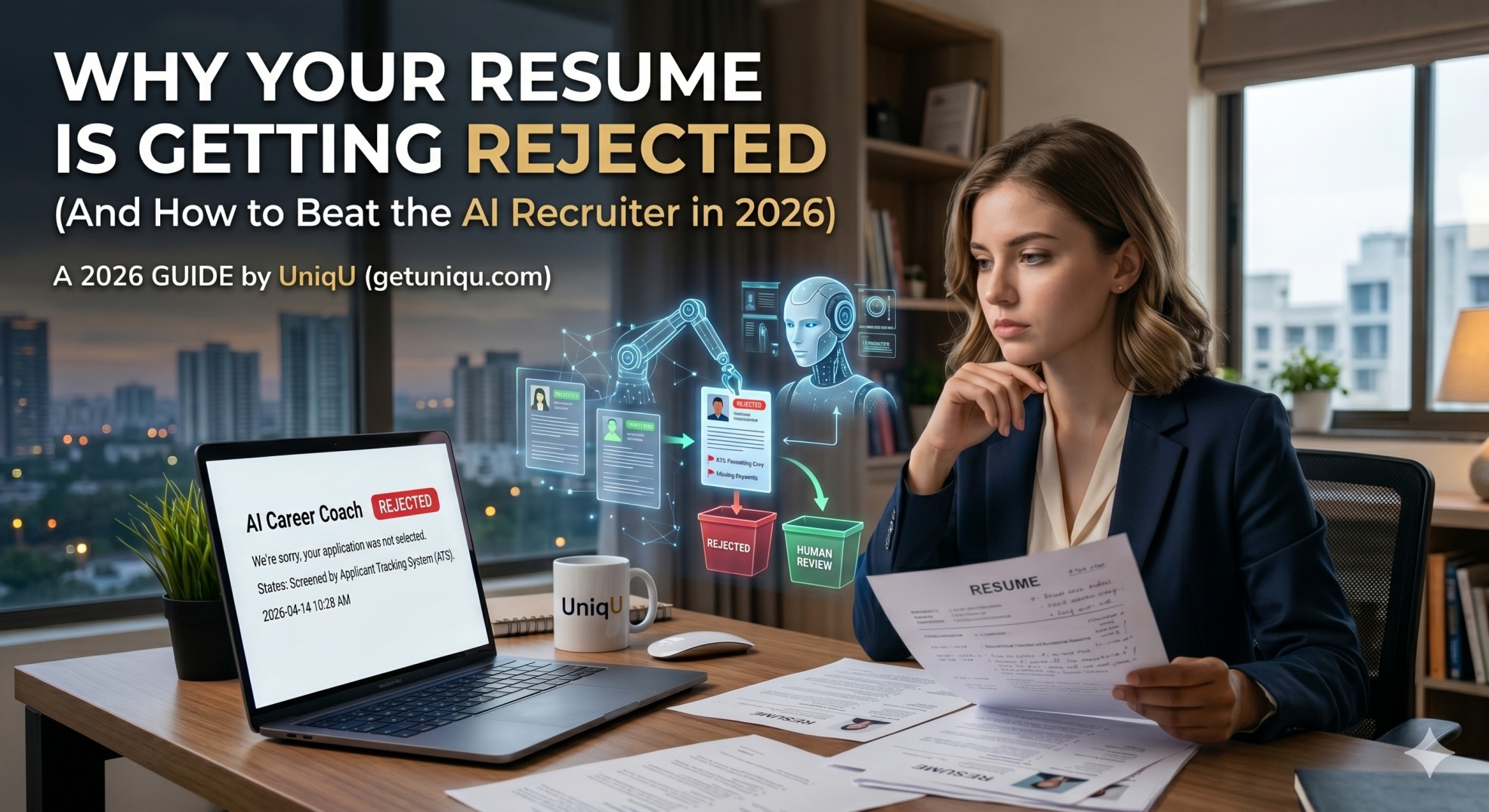
You have the experience. You have the degree. You have the exact skills listed in the job description. So why are you receiving automated rejection emails within 24 hours of applying?
The harsh reality of the 2026 job market is that a human being is rarely the first person to read your resume. Today, over 99% of Fortune 500 companies and a vast majority of mid-sized startups use Applicant Tracking Systems (ATS) powered by AI to screen candidates. These systems act as digital bouncers, filtering out up to 75% of resumes before a hiring manager even knows you applied. If your resume isn’t engineered for a machine to read, your career is stalling before it even begins.
Here is the breakdown of why the AI gatekeepers are tossing your application, and exactly how to optimize your resume to break through to a human interview.
1. The “Pretty” Formatting Trap
Many job seekers use graphic design software like Canva to create visually stunning, multi-column resumes with custom graphics, skill sliders, and unique fonts.
The ATS Reality: AI parsers hate complex layouts. When an ATS scans a two-column resume or tries to read text embedded in a graphic, the data becomes scrambled. The system can’t figure out where your work history ends and your education begins. When the ATS gets confused, it automatically defaults to a rejection.
The Fix: Keep it clean. Use a standard, single-column format. Use standard fonts (like Arial, Calibri, or Times New Roman) and clear, traditional section headers (e.g., “Work Experience,” “Education,” “Skills”).
2. The Missing Context of Keywords
You already know you need keywords. The mistake most job seekers make is “keyword stuffing”—randomly pasting terms from the job description at the bottom of the page in a hidden font, or just listing them without context. Modern AI recruiters are smarter than that. They use Natural Language Processing (NLP) to understand how you used those skills.
The ATS Reality: If the job requires “Agile Project Management,” simply listing “Agile” under your skills section isn’t enough. The AI is looking for contextual proof of that skill in your actual work experience bullets.
The Fix: You need to weave exact-match keywords directly into your achievements. Instead of saying “Managed projects,” say, “Led a cross-functional team using Agile Project Management methodologies to deliver the software update 3 weeks ahead of schedule.”
3. Vague Responsibilities Instead of Hard Metrics
AI screening tools are programmed to look for impact, not just a list of daily chores. “Responsible for handling customer complaints” tells the system what your job title was, but it tells them nothing about how good you were at it.
The ATS Reality: Algorithms are trained to hunt for numbers, percentages, and dollar signs. Resumes lacking quantifiable data receive significantly lower scores in the candidate ranking system.
The Fix: Apply the “X-Y-Z formula” championed by top tech recruiters: Accomplished [X] as measured by [Y], by doing [Z]. * Weak: Increased sales in my territory.
- ATS-Optimized: Increased Q3 enterprise software sales by 24% ($1.2M in new revenue) by implementing a new automated email outreach sequence.
The Ultimate Hack: Fighting AI with AI
Trying to manually guess what a specific Applicant Tracking System wants to see is exhausting, and tailoring a resume by hand for 50 different job applications is a full-time job in itself.
If companies are using AI to screen you out, you need to use AI to get yourself in.
Instead of guessing, you can use advanced resume optimization tools to instantly align your experience with exactly what the hiring algorithms are looking for. By running your current resume through an AI career coach, you can automatically identify missing keywords, fix structural formatting errors that confuse ATS parsers, and rewrite weak bullet points into high-impact, data-driven achievements.
The Bottom Line
In today’s competitive landscape, being qualified isn’t enough. You have to be “parseable.”
Stop letting a formatting error or a missing keyword stand between you and your dream job. Simplify your layout, quantify your achievements, and leverage AI tools to ensure your resume speaks the exact language the recruitment algorithms demand. Once you get past the bots, your real experience can finally do the talking.
Frequently Asked Questions (FAQs) About ATS Resumes
What is the best file format for an ATS-friendly resume? Unless the job application explicitly requests a PDF, the safest file format for an Applicant Tracking System is a standard Microsoft Word document (.docx). While modern ATS software can read PDFs, some older systems struggle to parse the text accurately from PDF files, leading to scrambled data and automatic rejections.
How do I know if my resume is ATS compatible? An ATS-compatible resume features a single-column layout, standard web-safe fonts (like Arial or Calibri), clearly labeled sections (e.g., “Work Experience”, “Education”), and is free of complex graphics, tables, or text boxes. The most effective way to test compatibility is to run it through an AI-driven resume optimization tool that simulates the exact parsing process.
Do ATS systems look for exact keyword matches? Yes, but context matters. Older ATS models relied heavily on exact keyword matching, but modern AI recruiters use Natural Language Processing (NLP). This means the system evaluates how you used the keyword in context. Instead of just listing “Project Management” in a skills section, the ATS wants to see it applied in a bullet point detailing a specific, measurable achievement.
