
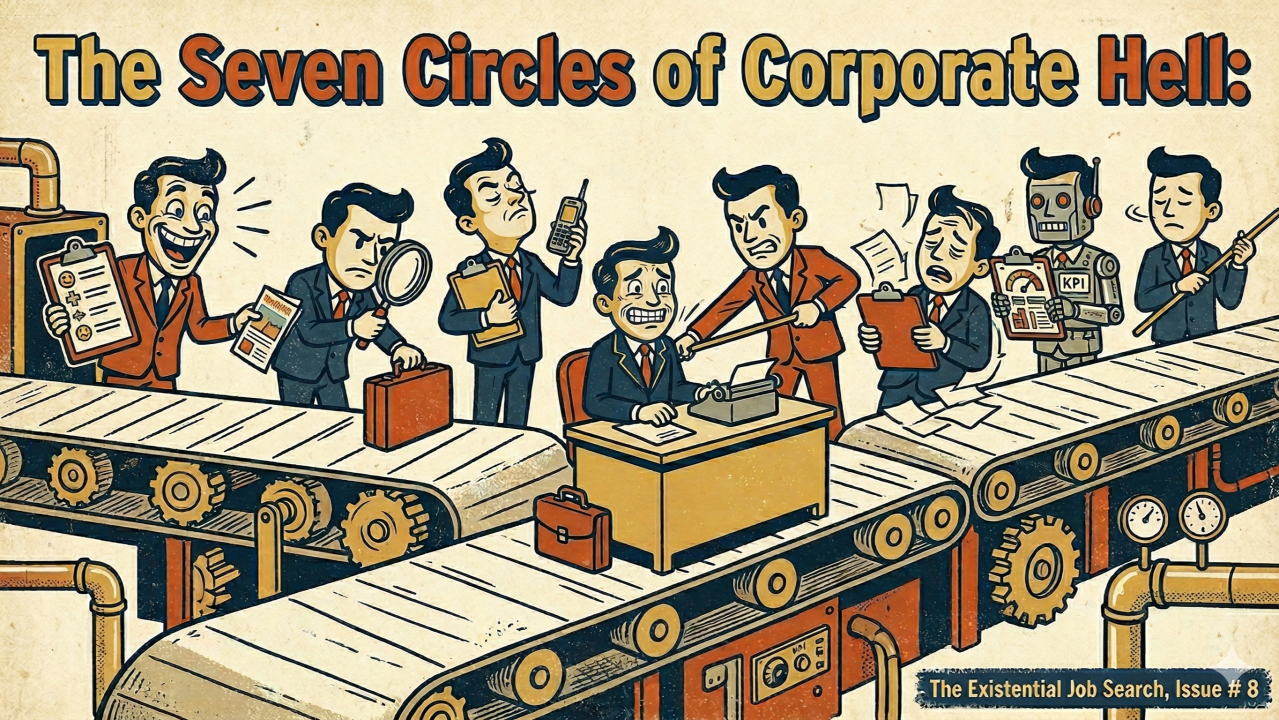
The Existential Job Search: Issue #8
If you’ve ever found yourself in a fourth-round interview, explaining your "greatest weakness" to a person whose job title you don’t understand and who clearly hasn't read your resume, you aren’t in a hiring process. You’re in a hostage situation.
Welcome to the Existential Job Search Club. If you’re new here, welcome to the support group for the professionally exhausted. We don't have coffee, but we do have a shared, burning resentment for the modern corporate machine. No sugar, either.
Modern hiring has evolved from a simple conversation into a performative endurance test. It’s no longer about whether you can do the job; it’s about whether you can survive the Interview Marathon without losing your mind, your dignity, or your story.
For those who have been following along, you’ve already survived the digital gauntlet, the Human Zoo, and the silence of Purgatory. But for everyone else, here is the unvarnished reality: Companies don't hire people anymore. They form committees to avoid the blame of a bad hire.
You are currently being poked and prodded by a series of corporate stakeholders who haven't spoken to each other, don't agree on what the role actually is, and are all looking for a reason to say "no" so they don't have to take the risk of saying "yes."
Your goal now isn't just to be the best candidate. It's to be the one with the most stamina. It's an endurance test, and you, my friend, are the unwilling participant in a game where the rules are made up and the points only matter if the VP of Synergy had a good breakfast.
I. The Stakeholder Safari: Know Your Corporate Species
dYou aren't interviewing with "the company." That's a naive, quaint notion from a time when people stayed at one job for forty years and got a gold watch at the end. You are interviewing with a series of distinct corporate species, each with their own fears, agendas, and preferred methods of psychological warfare. To survive, you must understand their natural habitats and their predatory instincts.
- The Peer (The Vibe Check):This is the most dangerous interview. Your future colleagues. They don't care about your ROI or your strategic vision. They care if you're going to steal their credit, eat their lunch (literally, from the communal fridge), or be annoying on Slack. They are looking for reasons to say no, because every new hire is a potential threat to their carefully constructed corporate ecosystem.
Your goal here is to project competence without threat. Be helpful, not brilliant. Be collaborative, not competitive. Be the person they wouldn't mind being stuck in an airport with for six hours during a blizzard. If you come across as too smart, they’ll fear for their own jobs. If you come across as too dumb, they’ll fear for their own workload. You have to hit that sweet spot of "competent enough to do the work, but not so ambitious that you’ll be my boss in six months."
- The Cross-Functional Partner (The Friction Test): These are the people from other departments who will inevitably have to work with you. They want to know if you're going to make their job harder. They are looking for reasons to say no because every new hire is a potential bottleneck, a new set of demands, a fresh source of inter-departmental friction.
They will ask questions designed to uncover your potential for creating headaches. Your goal is to project extreme collaboration and low maintenance. Emphasize how you solve problems for them, how you streamline processes, how you proactively communicate. You are not a burden; you are a lubricant for the corporate machine. You are the person who will make their life easier, not the person who will send them a 4:55 PM Slack message on a Friday.
- The Wildcard Executive (The "Who Are You Again?" Species): This is the person from a completely unrelated department who was pulled in at the last minute because the original interviewer had a "conflict" (which is corporate speak for "I forgot this was on my calendar and I’m currently at a long lunch"). They have no idea why they are there. They haven't read your resume. They might not even know what role you're applying for.
They will ask a question that is so wildly irrelevant it will make your brain stall. "If you were a kitchen appliance, which one would you be and why?" or "How many tennis balls can you fit in a Boeing 747?" Your goal here is to remain unshakeable. Don't show confusion. Don't show frustration. Just answer the ridiculous question with the same gravity you would use to discuss a multi-million dollar budget. They are testing your ability to handle corporate nonsense without rolling your eyes. It’s a vital skill.
- The Ghost of the Predecessor (The Comparison Species): This interviewer is obsessed with the person who just left the role. Either they loved them and are looking for a clone, or they hated them and are looking for the exact opposite. They will ask questions that are thinly veiled comparisons. "How do you handle [Specific Task]?" really means "The last guy was a disaster at [Specific Task], please tell me you aren't like him."
Your goal is to figure out which ghost you're dealing with. If they loved the predecessor, mirror their strengths. If they hated them, highlight how your approach is fundamentally different. You aren't just a candidate; you are a corrective measure for a past corporate trauma.
- The Final Boss (The "Visionary" Species): They haven't read your resume. They might have glanced at a bullet point or two while they were in the elevator, but mostly, they're there for the "vibe." They will ask a vague, philosophical question about "vision," "culture," or "the future of the industry." These questions usually have no right answer, only a right performance.
Your goal is to mirror their ego and speak in broad, strategic strokes. Nod sagely. Use words like "synergy," "paradigm shift," and "holistic ecosystem." Make them feel like you understand their grand, abstract pronouncements, even if you're secretly wondering if they know what day it is. They want to feel like they are hiring a "thought leader," not just a person who can do the work. Give them the performance they crave.
- The "Culture Fit" Zealot (The Gatekeeper Species): This person doesn't care about your skills. They care if you like the same craft beer as the rest of the team or if you have a "growth mindset" (which is corporate speak for "willing to work 60 hours a week for 40 hours of pay"). They will ask questions about your hobbies, your favorite books, and how you handle "ambiguity."
Your goal is to sound like the most interesting, yet perfectly compliant, person in the world. You have hobbies, but they aren't too time-consuming. You read books, but they are all about leadership or personal development. You love ambiguity because it’s an "opportunity for innovation." You are the human equivalent of a beige wall—inoffensive, reliable, and perfectly suited to any corporate environment.
- The Technical Sadist (The "Prove It" Species): Usually found in engineering or data roles, but they exist everywhere. They are there to prove that they are smarter than you. They will give you a "quick" task that actually takes four hours, or ask you to solve a complex problem on a whiteboard while they watch you sweat.
Your goal is to show your work, not just the answer. They want to see how you think, but mostly they want to see if you’ll crack under pressure. Stay calm. Explain your reasoning. Even if you have no idea what the answer is, describe the process you would use to find it. They value the struggle almost as much as the solution. It’s a hazing ritual, and you just have to survive it.
II. The Blame Committee: Why This Is Happening To You
You might be wondering why you have to talk to seven different people to get a job that mostly involves updating spreadsheets. The answer is simple: The Blame Committee.
In the modern corporation, making a decision is a high-risk activity. If a manager hires you and you turn out to be a disaster, that manager is responsible. But if a committee of seven people hires you and you turn out to be a disaster, then no one is responsible. It was a "collective failure of the process."
The marathon isn't about finding the best person; it's about distributing the risk of a bad hire across as many people as possible. Each interviewer is a human insurance policy. By the time you get to round six, you aren't a candidate anymore; you are a consensus. You are the person that no one had a strong enough reason to veto.
This is why the process feels so disjointed. The Peer is looking for a friend. The Partner is looking for a servant. The Boss is looking for a mirror. And the Blame Committee is just looking for a way to make sure they don't get fired if you accidentally delete the company's main database on your first day.
Understanding this is liberating. You don't have to be perfect for everyone. You just have to be "fine" enough for the committee to feel safe. You are a low-risk investment, a safe bet, a person who won't make anyone look bad. That is the true secret to surviving the marathon.
III. The Consistency Trap: Telling the Same Story Five Times (and Not Sounding Like a Broken Record)
The biggest danger of the interview marathon is fatigue. By round four, you're tired of hearing your own voice. You've told the story of your greatest achievement so many times it sounds like a bad stand-up routine you’ve performed at every dive bar in the tri-state area. This is the Consistency Trap—the fear of repeating yourself versus the fear of leaving out crucial information because you think you already told this person (you told the person from Tuesday).
The "Did I Already Say That?" Panic:It's real. You'll be halfway through a brilliant anecdote, and a cold dread will wash over you: Did I tell this to the Peer? Or the Partner? Or the HR Gatekeeper who looked like she was actively judging my life choices? This panic can derail your entire performance. You start to stutter, you lose your place, and suddenly you look like you’re lying about your own life.
The key is to understand that they haven't spoken to each other. Because they haven't. They are all too busy "internalizing feedback" or scheduling their next "synergy workshop." Even if they have a "debrief" meeting, it will consist of five people saying "Yeah, they seemed fine" while checking their emails.
The Solution: The Modular Narrative. Don't memorize a script. That's for the AI interview. For humans, you need a Modular Narrative. Develop three to five core "hero stories" from your past experience. Each story should highlight a different skill or achievement. But here's the trick: don't just recite the story. Adapt the lesson or the insight to the specific stakeholder you're talking to.
For the Peer, emphasize collaboration. For the Partner, highlight problem-solving. For the Boss, focus on impact and vision. The story remains the same; the moral of the story changes. This allows you to stay consistent without sounding like a pre-recorded message. You are a storyteller, and your audience is a group of corporate drones who are desperate for a narrative that makes sense.
IV. The "Do You Have Any Questions For Us?" Gauntlet: Turning the Tables (Subtly)
This is not a polite formality. This is your final opportunity to prove you're not just a performing seal. Asking the same generic question to five different people is a rookie mistake. It shows a lack of depth, a lack of engagement, and a lack of understanding of their internal corporate species.
Tailoring the Interrogation:
- For the Peer (The Vibe Check): "What's the most frustrating part of the day-to-day here that no one talks about?" This shows you're not afraid of reality and want to understand the trenches. It also builds an immediate bond of shared misery. If they hesitate, you’ve found the "toxic" part of the culture. If they answer honestly, you’ve found a potential ally.
- For the Cross-Functional Partner (The Friction Test): "Where does the friction usually happen between our two departments, and how can I help smooth it out?" This positions you as a solution-provider, not a problem-creator. You are the lubricant for their departmental gears. It tells them you aren't there to make their life harder, which is the only thing they care about.
- For the Wildcard Executive (The "Who Are You Again?" Species): "From your perspective in [Their Department], what’s the one thing this role could do to make your team’s life significantly easier?" This forces them to actually think about the role for thirty seconds. It also makes them feel important, which is the best way to win over a Wildcard who has no idea why they are in the room.
- For the Ghost of the Predecessor (The Comparison Species): "What’s the one thing the person previously in this role did exceptionally well, and what’s the one thing you’re hoping the next person will do differently?" This is a surgical strike. It forces them to reveal the "ghost" they are comparing you to. Their answer will tell you exactly which past trauma you are expected to heal.
- For the Final Boss (The "Visionary" Species): "What does success look like for this role in year one, from your high-level perspective, and what are the biggest strategic hurdles you foresee?" This mirrors their "visionary" language and shows you're thinking big picture. It makes them feel like they are hiring a "thought leader," not just a person who can do the work.
- For the "Culture Fit" Zealot (The Gatekeeper Species): "How has the company culture evolved over the last two years, and what’s the one thing you’re most protective of as the team grows?" This is music to a Zealot’s ears. It shows you value the "sacred" culture and are interested in its preservation. It’s the ultimate "I’m one of you" signal.
- For the Technical Sadist (The "Prove It" Species): "What’s the most complex technical challenge the team has solved in the last six months, and what was the biggest lesson learned from that process?" This turns the tables. You are now the one evaluating their technical prowess. It shows you value the "struggle" and the "process," which is the only thing a Sadist respects.
The Secret Weapon: Use the answers from earlier rounds as ammunition for later rounds. "When I spoke with [Peer's Name], they mentioned that X was a significant challenge. How does your team view that, and what strategies are in place to address it?" This makes you look like an insider, someone who listens, and someone who connects the dots. It makes you look like you belong. It also subtly lets them know that you’ve been paying attention, which is a rare and highly valued trait in the corporate world.
V. Managing the Fatigue: How Not to Look Like a Ghost by Round Six
By round six, your "professional detachment" is slipping into actual dissociation. Your forced smile feels like rigor mortis. Your enthusiasm is a carefully constructed lie. The interview marathon is designed to break you, to see if you can maintain your composure and your story under duress. It’s a test of your ability to handle the relentless, grinding boredom of corporate life.
The Psychological Erosion: Let’s stop pretending this is about "Zoom fatigue" or needing a glass of water. If this were a one-day event, you could power through on caffeine and spite. But the modern interview marathon is a multi-week, slow-motion psychological erosion. It’s the "calendar invite" that drops into your inbox like a small, digital bomb every Tuesday afternoon for a month.
I once heard of a candidate for a partner role at McKinsey who went through seventeen rounds of interviews. Seventeen. At that point, you aren't being hired; you're being broken. You've spent more time with the hiring committee than you have with your own family. You’ve told the story of your "greatest challenge" so many times that you’ve started to believe the lie yourself.
The Decay of the Self: The real danger isn't physical exhaustion; it's the decay of your personality. By round eight, you’ve smoothed out all your edges to appease the Blame Committee. You’ve become a mirror, reflecting back exactly what each stakeholder wants to see. You aren't a person anymore; you're a collection of "competencies" and "cultural alignments."
The multi-week gap between rounds is the worst part. It’s the "waiting room" of the mind. You spend three days over-analyzing a single furrowed brow from the Technical Sadist in round four, only to have the Culture Fit Zealot in round five tell you they "love your energy." It’s a rollercoaster of manufactured hope and administrative indifference.
The "I'm Still Excited" Lie: How do you manufacture enthusiasm in week four? How do you look a VP in the eye and say, "I'm so excited about this opportunity," when you secretly want to set your laptop on fire?
The corporate world is built on a foundation of this specific, high-level faking. If you can maintain the facade of "passionate engagement" while being poked and prodded for seventeen rounds, you’ve already proven you have the most important skill for senior leadership: The ability to endure absolute nonsense with a smile.
Don't worry about "resetting your human settings." By the time you get the offer, those settings will have been permanently overwritten by the corporate OS anyway. Just keep the mask on for one more round. You’re almost there. Maybe.
Conclusion: Crossing the Finish Line (Maybe)
The interview marathon is designed to break you. Surviving it is the final proof that you can handle the actual job (which, let's be honest, is mostly just surviving meetings that could have been emails and navigating internal politics). You've proven your stamina, your adaptability, and your ability to maintain a facade of enthusiasm under extreme duress. You are a survivor. You are a corporate warrior. You are, quite possibly, insane.
Go forth, keep the mask on, and try not to let them see you blink.
Rob
P.S.: Next Week: The Offer Letter (Or the Art of the Lowball)
You crossed the finish line. They want you. Now comes the final insult: The Offer Letter. Next week, we're talking about negotiation, benefits, and how to avoid being lowballed by a company that just put you through an Olympic-level endurance test. We’ll show you how to handle the "competitive" salary that hasn't changed since 2018 and how to ask for more without sounding like you’re ungrateful for the "opportunity."
Don't miss it.
(This issue of The Existential Job Search was brought to you by UniqU. Preparing for an interview marathon is exhausting. UniqU’s Deep Research tools give you the insider intelligence to tailor your narrative for each stakeholder, while our AI Interview Coaches help you practice your modular stories so you never sound like a broken record. Stop running blind. Train for your next marathon with UniqU for free here.)