

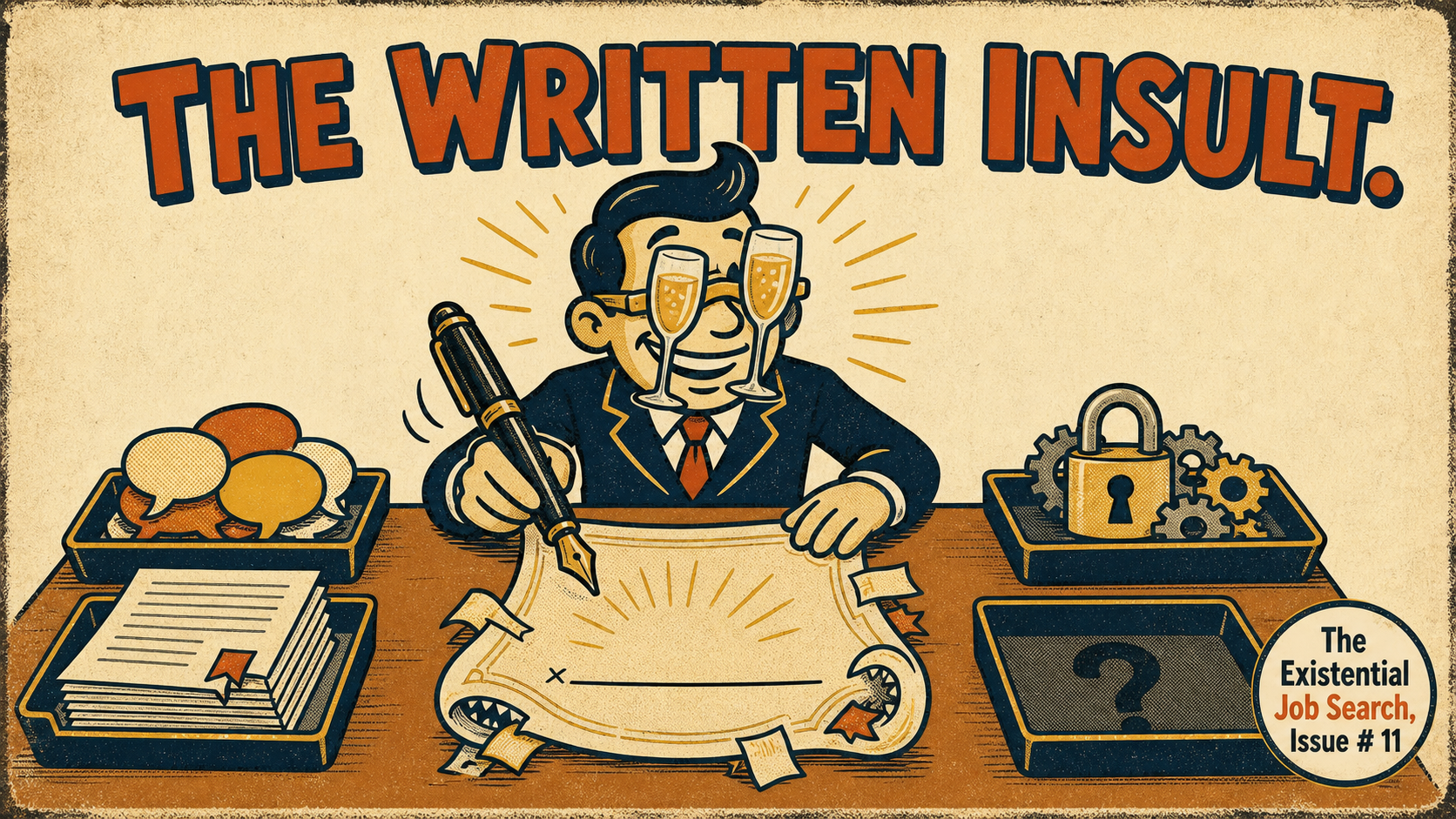
The Existential Job Search: Issue #11
It has arrived.
The email subject says "Offer."
Your nervous system, which has spent the last several months being rejected by software, ghosted by humans, and interviewed by a committee large enough to annex a small region, immediately starts producing champagne.
You skim the first line.
We are delighted to offer you…
Excellent. Delighted. Finally. Where do I sign? Shall I notify LinkedIn? Shall I stare meaningfully out of a window while imagining my new life as a person who no longer checks email with the emotional stability of a faulty smoke alarm?
Stop.
Put down the imaginary champagne flute.
Last week, you survived the verbal ambush. You discussed salary, bonus, benefits, flexibility, start dates, and possibly the grand cathedral phrase "long-term incentive opportunity." Everyone sounded warm. Everyone sounded aligned. Someone may even have said, "We will take care of that in the paperwork."
Now the paperwork is here.
And the paperwork has no memory.
It does not remember the reassuring nod.
It does not remember the "absolutely" on the video call.
It does not remember the flexible arrangement described as "how the team really works."
It contains words, numbers, conditions, and absences. Some of them are friendly. Some of them are boring. Some of them are doing suspicious little exercises in the corner.
Your job is not to assume the worst.
Your job is to inspect what you are actually being asked to accept.
Welcome to The Offer Reality Check.
Relief Is Not Due Diligence
The offer letter arrives at the exact moment when you are least emotionally equipped to review it.
You are tired. You are relieved. You may need the income. You may already be composing the resignation message in your head, selecting the new LinkedIn title, and imagining the luxurious future in which you no longer refresh your inbox like it owes you money.
That relief is real.
It is also dangerous.
Not because every employer is hiding a trap. Most inconsistencies are probably less theatrical than that. A template was used. A recruiter summarized something too casually. A manager assumed HR had included the detail. HR assumed the manager had approved it. Finance was waiting for a spreadsheet. Legal was in a meeting called "alignment" and therefore unavailable to perform alignment.
Corporate administration does not need a villain to ruin your Tuesday.
It only needs a shared folder, unclear ownership, and one person saying, "I thought that was already covered."
So do not read the offer as proof that they love you.
Do not read it as proof that they are trying to cheat you.
Read it as a written package you must understand before you make a life decision in a state of post-interview dehydration.
The Offer Reality Check
Take the offer, the contract, the attachments, the plan documents, and any written notes from the negotiation. Then separate everything into four buckets:
Discussed: what was said in calls, interviews, messages, or negotiations.
Written: what the offer letter, contract, or attached plan documents actually say.
Conditional: what depends on approval, performance, checks, eligibility, policy, discretion, or a future event.
Missing: what matters to your decision but is absent, vague, deferred, or hiding behind a phrase like "subject to company policy."
This is not a legal analysis. It is a clarity exercise.
You are turning a warm conversation into a cold comparison.
Romantic? No.
Useful? Extremely.
Think of it as the part of the process where the verbal promise has to put on shoes and walk across the room.
If it cannot make the journey into the document, do not pretend it has arrived.
A meaningful promise that appears only in your memory is not yet a written term. It may still be true. It may still be honored. It may have been said in good faith by someone who genuinely wants you on the team.
But it is still a memory.
Memories are lovely.
They are terrible compensation packages.
The Tour of the Paperwork, Unfortunately
You are not checking whether the salary number looks familiar and then galloping toward the signature line like the closing scene of a motivational film.
You are checking whether the entire package makes sense together.
Some answers will be in the offer letter. Some will be in the employment contract. Some will be in bonus plans, equity documents, benefit summaries, policy handbooks, or documents they have not yet sent because apparently mystery is now an HR delivery model.
The important question is not, "Does this look basically fine?"
The important question is, "Do I know where the answer lives?"
Here is what to inspect.
Base Pay: The Number That Should Not Require Archaeology
Start with the obvious number. Then become slightly less trusting.
Is the amount correct? Is the currency clear? Is the pay frequency clear? Does it match the role, level, hours, and location discussed? If there was a promised review date, is it actually written down?
This matters because "we usually review salaries after six months" is not the same sentence as "your salary will be reviewed on 1 March."
One describes a habit.
The other describes a date.
Neither guarantees an increase unless the document clearly says so.
Corporate language often sounds like commitment while quietly wearing escape shoes. Your task is to notice the shoes.
Variable Pay: The Percentage With Tiny Little Teeth
If the offer mentions a bonus, commission, or incentive, find the machinery underneath the percentage.
A "20% bonus opportunity" may be valuable.
It is not automatically the same as 20% more salary.
The word opportunity is doing an extraordinary amount of unpaid labor.
Ask:
- Is the number a target, a maximum, or a guaranteed amount?
- Who sets the goals?
- When are the goals set?
- Can the plan change?
- Is payment discretionary?
- Must you still be employed on the payment date?
- Is the first year prorated?
- What happens if your start date moves?
This is where many candidates get emotionally mugged by a percentage.
The offer says 20%.
Your brain says "lovely."
The plan document may say "subject to company performance, individual performance, active employment on the payment date, committee discretion, three lunar cycles, and the continued goodwill of a compensation process nobody has fully understood since 2017."
Read the machinery.
Do not negotiate with a headline.
Equity: Ten Thousand of What, Exactly?
"Equity" is a category, not an answer.
It can mean many things. Shares, options, restricted stock, phantom equity, profit participation, or a sentence designed mainly to make the total package feel like it has entered a better tax bracket.
Ask what instrument is being offered, how much, when it is granted, what approvals are required, how vesting works, and what happens if you leave.
If the value is material to your decision, get qualified legal and tax advice for your jurisdiction and circumstances.
Do not let a large, exciting number float through the conversation without units, conditions, or context.
Ten thousand of what, exactly?
Ten thousand options? Ten thousand shares? Ten thousand points in the Grand Loyalty Programme of Future Maybe?
The difference matters.
Your landlord, tragically, may not accept "equity vibes."
Probation, Notice, and Termination: The Part Everyone Skims Until It Matters
Locate the probation period, notice obligations, and any terms that change during probation.
Check whether your notice obligations and the employer's notice obligations are clearly described.
Then resist the urge to become an amateur employment lawyer after two search results and a comment thread.
These terms do not mean the same thing everywhere. Their effect can depend on local law, the contract, your status, and the circumstances. If a term could materially affect your income, exit options, or risk, flag it for qualified review before signing.
This is not because you are paranoid.
This is because "I assumed" is not a strategy. It is a sentence people say shortly before discovering that the boring paragraph was, in fact, the main character.
Benefits: "Excellent" Is Not a Plan Document
"Excellent benefits" is a mood.
You need details.
Which benefits are included? When does eligibility begin? Are there employee contributions or costs? Are dependants covered? Are there waiting periods? Which documents govern the plans? Can the plans change?
If the answer is "you will receive the handbook after joining," ask what can be shared now.
You are being asked to decide now.
That does not mean you need every microscopic plan clause before you can breathe. Use proportion. But if a benefit meaningfully affects your decision, do not accept a brochure-shaped fog bank.
There is a difference between "we offer health coverage from day one" and "details available after start."
One is information.
The other is a curtain.
Restrictive Clauses: The Boring Paragraph That Wants to Follow You Home
Read the sections about confidentiality, intellectual property, outside work, conflicts, non-solicitation, non-competition, and post-employment restrictions.
Slowly.
With caffeine.
Possibly while making the face people make when assembling furniture from instructions translated by a printer.
Do not rely on a stranger on the internet, including this newsletter, to tell you whether a clause is enforceable. That can vary significantly. If a restriction could affect your livelihood, side projects, clients, inventions, or next role, get jurisdiction-appropriate legal advice.
Also check whether you can actually comply.
If you have a side project, advisory role, existing invention, board position, consulting arrangement, or anything else that might collide with the contract, do not bury it in the hope that paperwork respects vibes.
Paperwork does not respect vibes.
Paperwork respects wording.
Location, Hours, and Flexibility: The Spiritually Remote Commute
If flexibility matters, look for specificity.
Where is your contractual or primary work location? How often are you expected onsite? Are hours defined? Is travel expected? Can the working pattern change, and through what process? Does the written term match what the hiring manager described?
"We are very flexible" can be true.
It can also mean "we are flexible as long as your flexibility involves being in the office Tuesday through Thursday and pretending Monday is a privilege."
"Remote-first in spirit" may mean you will be spiritually remote while physically commuting.
If working pattern is material to your decision, get it clear.
Not aggressive. Not dramatic. Clear.
Start Date and Conditions: Do Not Resign Into a Fog Machine
Check the proposed start date and every condition attached to the offer: references, background checks, right-to-work checks, approvals, documents, medical requirements where applicable, or anything else listed as a condition.
Until material conditions are clear and resolved, do not confuse excitement with certainty.
Especially before taking irreversible steps, such as resigning from another role.
The correct action depends on your contract, jurisdiction, and circumstances. Sometimes the condition is routine. Sometimes it is not. Sometimes everyone knows exactly what has to happen. Sometimes the process is being held together by one overworked coordinator and a portal last updated during the age of dial-up.
Ask what happens if a condition is delayed.
Ask whether the start date moves.
Ask when the offer becomes unconditional, if that concept applies in your situation.
The point is not to panic.
The point is to avoid building your next month on "probably."
How to Ask Without Sounding Like You Brought a Tiny Courtroom
You do not need to send a 47-point cross-examination titled Exhibit A: Why I Trust Nobody.
Group the important points. Be calm. Make it easy for the other side to answer.
Try this:
Thank you for sending the written offer. I am excited about the role and have reviewed the package carefully. Before I sign, I would like to clarify a few points so the document reflects our discussion.
We discussed [term]. Could you confirm how this will be recorded in the offer or applicable plan document?
The offer describes [term] as conditional or discretionary. Could you explain the condition and point me to the governing document?
I could not find [material item]. Where is that addressed?
If [condition] is not completed by [date], what happens to the proposed start date?
Once these points are clear, I will be able to complete my review promptly.
Notice what this message does not contain:
- an apology for reading the document;
- a declaration that you are "not trying to be difficult";
- a ten-paragraph autobiography;
- the phrase "I am sure it is fine";
- a legal monologue delivered through clenched teeth.
You are allowed to understand an agreement before accepting it.
A company that spent six interviews evaluating your judgment can survive seeing you use it.
The Written Counteroffer
If the written package does not match the discussion, or if you want to negotiate a material term, do it clearly.
Do not send a cloud of disappointment.
Send a decision-shaped request.
Thank you for the offer for the [Role] position. I am enthusiastic about the opportunity and the work we discussed, particularly [specific responsibility or problem].
After reviewing the complete written package, I would like to revisit [base salary / bonus / equity / working pattern / other term]. Based on [the scope discussed, relevant experience, market evidence, or another defensible reason], I am seeking [specific revised term].
I would also like the offer to reflect our discussion that [verbal term], so we have a shared written understanding before I accept.
If we can align on those points, I would be pleased to move forward. I am available to discuss them on [times], and I would appreciate the revised terms in writing afterward.
This is not a courtroom speech.
It is a professional request tied to the role and the package.
Make the request.
Explain the reason.
Ask for the revision in writing.
Then stop typing.
Do not add three more paragraphs because silence feels scary. Silence is allowed. Let the email end before it starts wearing a cape.
The Material-Omission Rule
Here is the decision rule:
If a term materially affects your pay, ability to do the job, freedom to leave, exposure to risk, or decision to accept, do not resolve the ambiguity in your head. Resolve it in writing or obtain qualified advice before signing.
Not every typo requires a constitutional convention.
Not every missing detail is sinister.
Use proportion.
But if your answer is, "I am sure they meant…" you do not have clarity.
You have fan fiction.
The four buckets tell you what to do next:
Discussed and written: confirm the wording is accurate.
Written and conditional: understand the condition and its owner.
Discussed but missing: ask for written confirmation or revision.
Missing and material: pause the decision.
If the employer will not clarify a material point, that refusal is information.
It may not tell you their motive.
It does tell you what you would be accepting: uncertainty.
The Offer Is Good News. Read It Anyway.
You do not need to kill the joy.
You earned the relief. You survived the applications, the silence, the interview marathon, the reference checks, and the verbal negotiation. The offer is good news.
It is also a decision.
Celebrate the arrival.
Then inspect the reality.
Separate what was discussed, what is written, what is conditional, and what is missing. Ask calm questions. Put material revisions in writing. Get qualified help where a clause could meaningfully affect your rights, income, options, or obligations.
Champagne goggles off.
Reading glasses on.
That's all for this week.
Go forth and be slightly less miserable in your job hunt.
Rob
Next week: The Resignation Ritual
The written terms are clear. You have accepted the offer. Now you have to tell your current employer and survive the guilt, flattery, panic, and sudden declaration that you were "always part of the long-term plan."
Next week, we will cover how to resign without turning a two-sentence decision into a corporate hostage negotiation.
Editorial Memo
Revision Summary
- Removed the comparison table entirely and replaced it with prose buckets plus a "Tour of the Paperwork" structure suitable for LinkedIn newsletters.
- Preserved the approved thesis and Episode 10 to Episode 12 continuity.
- Increased humor after the opening with more TEJS-style corporate absurdity, but kept jokes aimed at systems, incentives, paperwork, and vague corporate language.
- Reduced technical density by converting checklist sections into practical explanations with fewer repeated question clusters.
- Kept legal, tax, equity, restrictive-clause, probation, notice, and jurisdiction caveats visible without letting them dominate the piece.
- Restored the established TEJS sign-off from the style guide.
Evidence-Integrity Flags
- Employment terms, notice, probation, restrictive clauses, benefits, tax, and equity treatment remain jurisdiction-sensitive and require qualified review before publication.
- No new statistics, laws, external citations, first-person author anecdotes, or UniqU product claims were introduced.
- The sponsor block remains omitted because no approved UniqU capability specific to offer comparison or negotiation preparation was attached to this task.
Author Queries
- Should this edition target a specific jurisdiction or remain jurisdiction-neutral?
- Is there an approved UniqU P.S. for offer review or negotiation preparation, or should the sponsor block stay omitted?
- Does Rob want to add a brief first-person line from his own experience reviewing offers, or should the draft remain general?
Readiness
- Status: draft ready for author review after requested rewrite.
- Remaining risks: legal/employment review still required before publication if the article will make jurisdiction-specific claims.
- Recommended next step: human-owned author review for tone, jurisdiction, and sponsor decision.