

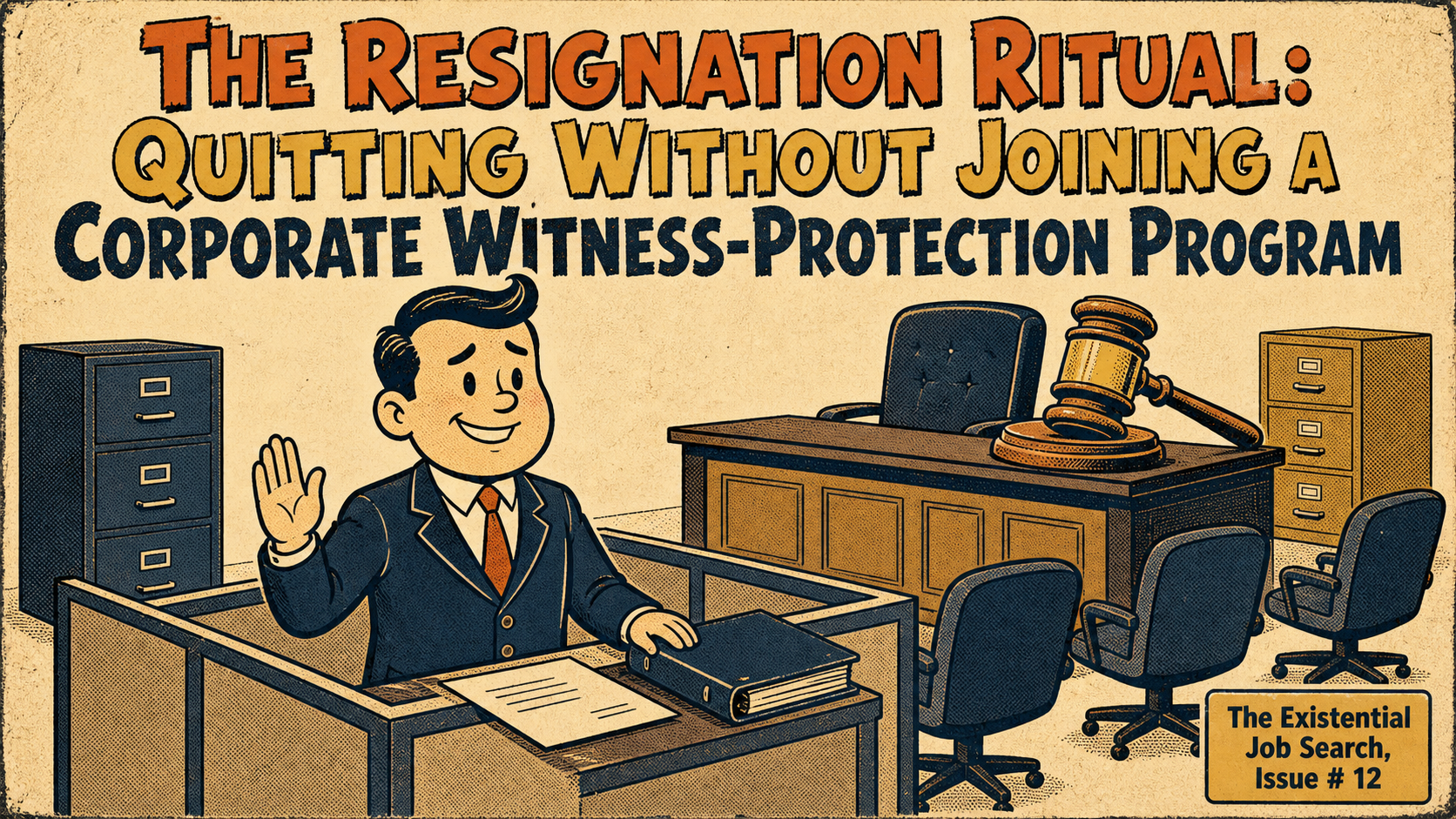
Once you have accepted a satisfactory written offer, resignation is not a confession or a loyalty trial. It is an operational transition: confirm the new role is solid enough for your risk tolerance, prepare a short script, resign in writing, evaluate any counteroffer against the original reasons you chose to leave, set boundaries around emotional pressure, and leave behind a clean, finite handover record.
The Existential Job Search: Issue #12
You did it.
You got the written offer.
You read the document without letting relief climb into the driver's seat wearing champagne goggles. You checked the salary, the conditions, the start date, the benefits, and the little paragraph that looked harmless until it tried to follow you into your next job.
And then you accepted.
Excellent.
Now comes the part everyone pretends is simple: telling your current employer you are leaving.
This should be a two-minute operational update.
In practice, it can become a surprise loyalty trial conducted by a manager who suddenly remembers your strategic importance after months of treating your career development like a printer jam.
The calendar fills. The tone changes. Someone says they are "disappointed." Someone asks what they could have done differently, as though you are now the exit-interview therapist for a system that had several business quarters to develop listening skills.
Then, perhaps, the counteroffer arrives.
Money appears. A title appears. Flexibility appears. The career path that had been trapped in committee since the early Bronze Age suddenly has a slide deck and urgency.
Welcome to The Resignation Ritual.
Do not be cold.
Be clear.
You are not confessing a betrayal. You are managing a transition.
Before you resign, check the ground under your feet
Resignation feels like the first step after acceptance.
It is not.
The first step is making sure you are not resigning into a fog machine.
Before you tell anyone, confirm the basics of the new role:
- the accepted written offer;
- the start date;
- any remaining checks, approvals, references, right-to-work steps, or other conditions;
- the notice period you intend to give;
- when your current benefits may end;
- what happens to accrued leave, PTO, commission, bonus, equity, expenses, equipment, and final pay;
- whether you have restrictive clauses, repayment terms, confidentiality obligations, garden-leave terms, nonsolicits, noncompetes, or outside-work restrictions;
- which personal files you need to retrieve without touching employer data, client information, code, records, or anything your current employer owns.
This is not legal advice. It is a reminder that employment terms are annoyingly local. Notice, final pay, leave payout, benefits, references, deductions, restrictive covenants, and resignation procedure can depend on your country, state, province, contract, policy, award, agreement, collective arrangement, role type, and a set of documents you may have optimistically ignored because life is short.
Check the actual rules that apply to you.
If a clause could affect your income, health coverage, new job, side work, clients, inventions, immigration status, or ability to start on time, get qualified advice before you improvise.
"I saw a confident person on the internet say this is unenforceable" is not a transition plan. It is a small bonfire wearing sunglasses.
The resignation script
Your resignation conversation does not need a TED Talk.
It needs three things:
- the decision;
- the effective date or last working day;
- a calm promise to support a professional handover.
That is it.
Try this:
I wanted to let you know directly that I have accepted another role and am resigning from my position. My last working day will be [date], in line with [my notice period / the notice period I understand applies]. I will send this in writing today and prepare a handover plan for the transition.
Then stop.
Do not add:
- a courtroom defense of your life choices;
- a detailed ranking of every disappointment since onboarding;
- "I feel terrible";
- "I hope this is okay";
- "Please don't hate me";
- "I can still be available after I leave";
- "Obviously I will do whatever you need."
You are resigning.
You are not applying for permission to resign.
Some managers will handle this beautifully. They will be disappointed, professional, maybe even generous. Treasure these people. Send them the written note, agree the handover, and leave the place better than you found it.
Other managers will experience your resignation as a personal audit.
Prepare accordingly.
Put it in writing
After the conversation, send a short written resignation.
Not a novel. Not a farewell album. Not a heavily edited emotional memoir titled The Years Took Much From Us, But Also There Were Snacks.
Write:
Subject: Resignation
Hi [Manager],
As discussed, I am resigning from my role as [title]. My last working day will be [date], based on [notice period / agreement / policy].
I will prepare a handover summary covering current work, key contacts, outstanding decisions, access or equipment items, and any transition points we should agree before my last day.
Thank you for the opportunity to contribute to [team/company]. I will do what I can to make the transition orderly.
Best,
[Name]
This confirms the decision. It records the date. It offers a professional handover. It does not invite negotiation through emotional weather.
If your employer has a required resignation process, follow it. If your contract or policy requires a particular form, destination, or notice method, use that. If your role means resignation may trigger garden leave, client restrictions, security procedures, regulated obligations, or special access rules, do not rely on newsletter vibes.
Use the correct procedure.
Then save a copy for your own records.
The counteroffer is not automatically evil
Now for the dramatic part.
Sometimes the company counters.
This is the moment your brain gets very loud.
Part of you thinks, "Ah, finally, they see my value."
Another part thinks, "Where was this money when I was eating spreadsheet glass in February?"
Both parts deserve a chair.
A counteroffer is not automatically an insult. It may be a sincere attempt to retain a valued person. It may also be emergency budget theatre performed because your departure created an operational problem.
Do not ask whether the counteroffer is flattering.
Ask whether it changes the reasons you decided to leave.
Research on quitting does not support the tidy little myth that people leave only for money. Pew found that U.S. workers who quit in 2021 most commonly pointed to low pay, lack of advancement, and feeling disrespected. Gallup's retention work also treats pay and benefits as one major reason among a wider cluster that includes culture, engagement, wellbeing, and work-life issues.
Translation: a raise may solve the arithmetic while leaving the machine intact.
And the machine is often why you started interviewing in the first place.
The Counteroffer Reality Grid
Before resignation day, write down your reasons for leaving.
Do this while you are calm.
Do this before a senior person appears with emergency affection and a number that makes your financial anxiety briefly sit down.
Use seven prompts.
Original reasons for leaving: What actually pushed you out? Pay, advancement, manager trust, workload, instability, values, location, flexibility, disrespect, boredom, burnout, role mismatch, something else?
Material change: Does the counteroffer fix the original issue, or merely decorate it?
Trust: If this offer was possible, why did it require your resignation to appear?
Timing: Is the new promise immediate and written, or is it another soft commitment scheduled for the sacred corporate season of "soon"?
Career path: Does staying improve your next two years, or only prevent this month's awkward staffing problem?
Compensation: Is the money real, complete, and documented? Does it affect bonus, equity, benefits, title, reporting line, responsibilities, workload, or only base salary?
Downside risk: If you stay, how will your employer read your loyalty, future promotion case, access to sensitive work, and next resignation attempt?
You do not need a universal rule like "never accept a counteroffer."
Universal rules are comforting because they save us from thinking. Unfortunately, jobs keep arriving with contracts, humans, mortgages, health plans, and other forms of narrative inconvenience.
Use the grid.
If the counteroffer changes the structure, puts the change in writing, resolves the reason for leaving, and leaves you comfortable with the trust implications, you have a decision to make.
If it only adds panic money to the same role, same manager, same stalled promotion, same workload, and same mysterious smell coming from the culture microwave, you also have a decision.
It may already be made.
How to answer "what would make you stay?"
This question sounds innocent.
It is not always a trap. But it does require discipline.
If you are open to a counteroffer, answer in concrete terms.
I would need to see a written proposal that addresses the reasons I accepted the new role: [compensation / role scope / reporting line / flexibility / advancement / workload / other factor]. I would also need clarity on timing and authority, not only intent.
If you are not open to a counteroffer, do not perform a fake negotiation because silence feels rude.
I appreciate the question, but I have made my decision and accepted the other role. I am focused now on making the transition orderly.
If they press:
I understand this creates difficulty for the team. My decision is final. The most useful conversation now is the handover plan.
That last sentence is your little emergency brake.
Use it whenever the conversation tries to drive into a swamp wearing business casual.
Boundary language for the emotional theatre
Resignations can activate every corporate emotion except the useful one: planning.
You may hear:
"I'm disappointed."
I understand. This was not an easy decision, and I want to handle the transition professionally.
"We thought you were loyal."
I have tried to contribute well while I have been here. I am making a career decision now, and I want to leave the work in good order.
"Can you stay longer?"
My current last working day is [date]. I can prioritize the handover around the highest-risk items before then.
"Can you help after you leave?"
After my last day, I will be focused on my new role. I can document the key information before I leave.
"Don't tell anyone yet."
I can respect a reasonable communication plan. I would like us to agree who needs to know, when they need to know, and how work will be transferred.
"This is terrible timing."
I understand the timing is difficult. That is why I want to be precise about what must be handed over before [date].
Notice the pattern.
You acknowledge. You do not absorb. You redirect to the transition.
That is the whole ritual.
The handover plan that does not eat your remaining life
A professional handover is not a vow to solve every problem your employer avoided for the last two years.
It is a bounded record of what someone else needs to know.
Create a simple handover summary:
- active projects and current status;
- decisions waiting for approval;
- upcoming deadlines;
- key contacts;
- files, systems, and access locations;
- recurring meetings that need a new owner;
- risks or loose ends;
- equipment return and access cutoff items;
- anything confidential that must remain confidential.
Then ask your manager to prioritize.
I have listed the main transition items. Given the time available, which three to five items should I prioritize before my last day?
This sentence is a tiny administrative miracle.
It stops "handover" from becoming a magical container into which everyone pours unresolved work, ancient anxiety, and the task that technically belonged to a steering committee in 2023.
You are being professional.
You are not volunteering to become the ghost employee who haunts the Slack workspace after departure.
Protect the transition record
Keep your resignation boring and traceable.
Save copies of your resignation letter, accepted last day, handover plan, equipment return confirmation, benefits or final-pay communications, and any agreement about notice, leave, garden leave, or early release.
Do not secretly copy company files. Do not take client lists, code, pricing, internal decks, emails, documents, designs, roadmaps, candidate files, personnel records, or "just a few examples for my portfolio" unless you have explicit permission and it complies with your obligations.
Retrieve your own personal materials in line with policy.
The distinction matters.
Your goal is to leave with a clean record, not a USB drive full of future litigation confetti.
Leave like a professional, not a penitent
Resignation has a strange way of making competent adults apologize for having a career.
Do not do that.
You can be grateful without being owned.
You can be kind without being available forever.
You can be professional without letting a counteroffer, a guilt trip, or a sudden outbreak of managerial emotion rewrite the decision you already made.
Confirm the offer. Prepare the script. Resign in writing. Evaluate the counteroffer against the original reasons for leaving. Set boundaries. Build a handover record that is useful, finite, and boring.
Boring is good.
Boring means nobody has to reconstruct the last two weeks from memory, Slack fragments, and the haunted expression of the person who inherited your projects.
You accepted a new role because you chose the next step.
Now make the exit match the decision.
Calm.
Documented.
Finite.
That's all for this week.
Go forth and be slightly less miserable in your job hunt.
Rob
Next week: Dead Employee Walking
You have resigned. Congratulations. You are now somehow both essential and already gone. Next week, we will cover the notice-period purgatory: handovers, awkward meetings, sudden exclusion, strange affection, and the art of leaving without spending your final days as the company's emotional support spreadsheet.
Personal/Profile LinkedIn Post
Resigning should be a two-minute operational update.
Too often, it becomes a loyalty trial.
If you have accepted a written offer, the goal is not to perform guilt, invite a counteroffer debate, or become available forever after your last day. The goal is to make the exit calm, documented, and finite.
Before you resign:
- Confirm the new offer, start date, and any remaining conditions.
- Check the notice period and process that apply to your contract, policy, role, and location.
- Understand what may happen to benefits, final pay, leave, bonus, equity, equipment, and restrictive clauses.
- Prepare one short resignation script and follow it with a written note.
- If a counteroffer appears, compare it with the reasons you decided to leave. A raise may fix the arithmetic while leaving the same manager, workload, or career path intact.
- Build a handover plan that names active work, pending decisions, risks, contacts, access, and the few priorities your manager actually wants handled first.
This is practical guidance, not legal advice. Employment rules are local, and anything that affects income, health coverage, immigration, restrictive covenants, clients, inventions, or your ability to start the next role deserves qualified advice.
This week's TEJS is Issue #12: "The Resignation Ritual." It covers the resignation script, written notice, counteroffer grid, boundary language, and finite handover plan.
Read it when it lands, especially if your next career step is about to collide with someone's sudden discovery that you were "strategically important."
UniqU Company LinkedIn Post
https://www.linkedin.com/feed/update/urn%3Ali%3Ashare%3A7498619049606729728
Company Post Copy
Resigning should be a two-minute operational update.
Too often, it becomes a loyalty trial.
If you have accepted a written offer, the goal is not to perform guilt, invite a counteroffer debate, or become available forever after your last day. The goal is to make the exit calm, documented, and finite.
Before you resign:
- Confirm the new offer, start date, and any remaining conditions.
- Check the notice period and process that apply to your contract, policy, role, and location.
- Understand what may happen to benefits, final pay, leave, bonus, equity, equipment, and restrictive clauses.
- Prepare one short resignation script and follow it with a written note.
- If a counteroffer appears, compare it with the reasons you decided to leave. A raise may fix the arithmetic while leaving the same manager, workload, or career path intact.
- Build a handover plan that names active work, pending decisions, risks, contacts, access, and the few priorities your manager actually wants handled first.
This is practical guidance, not legal advice. Employment rules are local, and anything that affects income, health coverage, immigration, restrictive covenants, clients, inventions, or your ability to start the next role deserves qualified advice.
This week's TEJS is Issue #12: "The Resignation Ritual." It covers the resignation script, written notice, counteroffer grid, boundary language, and finite handover plan.
Read the full edition here:
https://www.linkedin.com/pulse/resignation-ritual-quitting-without-joining-corporate-maciejewski-onpme/
Hero image for company post: artifact 12433 (scoped copy of TEJS hero artifact 12396).