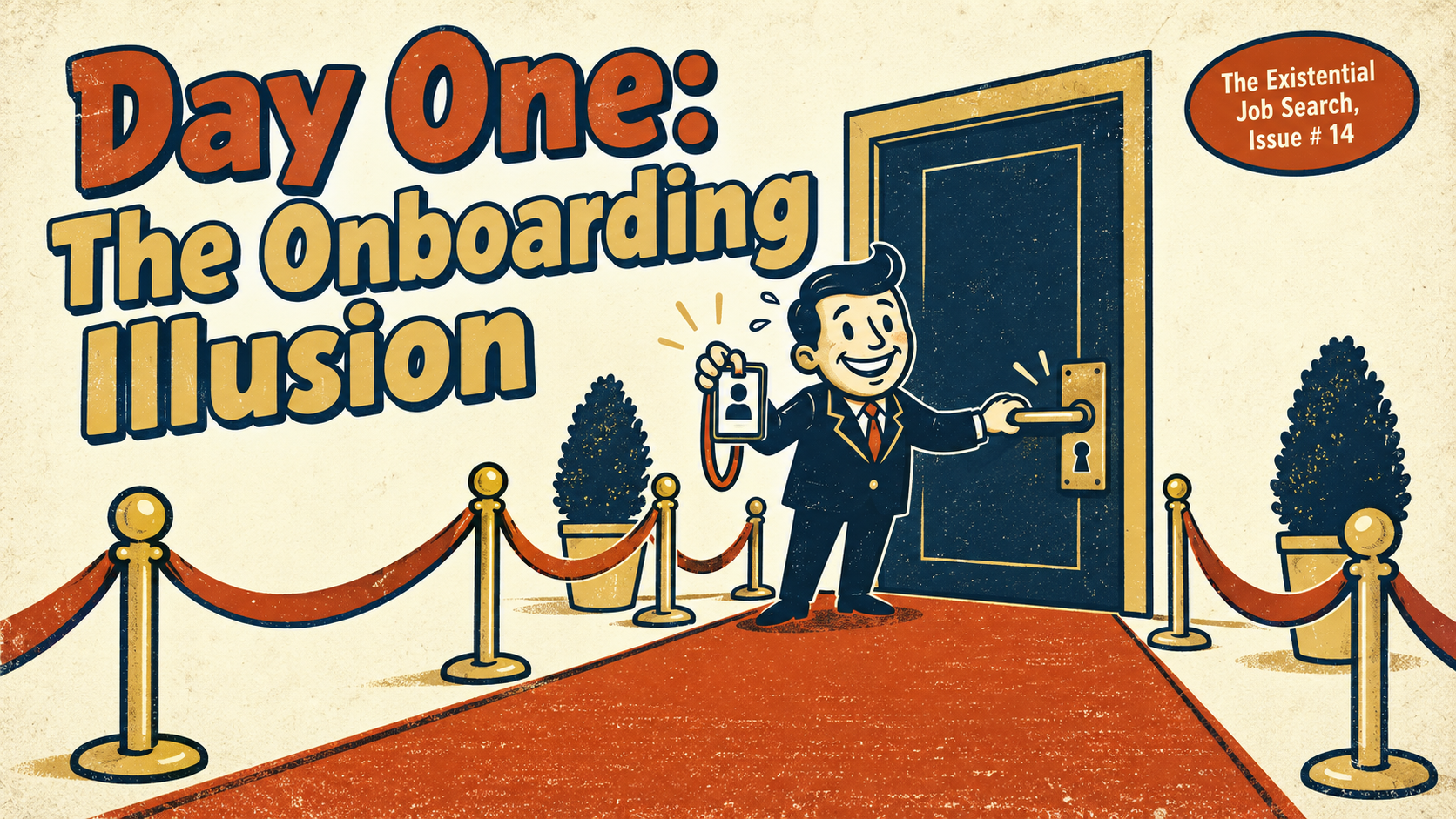

<p><strong><em>tl;dr: Your first week is not a test of whether you can look confident while locked out of the tools you need. Build a First-Week Reality Map of access, expectations, stakeholders, decisions, and warning signals; align it with your manager in writing; and judge the onboarding process by whether clear gaps are owned and corrected, not by whether day one looked polished.</em></strong></p><h2>The Existential Job Search: Issue #14</h2><p>You arrive early because this is your new job, and punctuality still feels like a personality test.</p><p>Reception cannot find your name.</p><p>Your laptop exists, but its password belongs to Martin, who left in 2024. Your security badge opens the building but not your floor. Your manager is "just jumping between things" and will be with you after a meeting that appears to have started in the previous financial year.</p><p>By 10:17 a.m., you have completed the mandatory first task: wondering whether accepting the offer was a clerical error.</p><p>Welcome to <strong>Day One: The Onboarding Illusion</strong>.</p><p>The hiring process sold you a functioning organization. Day one may reveal a temporary construction site staffed by friendly people who assume someone else ordered the doors.</p><p>Last week, you survived <a href="https://www.linkedin.com/pulse/dead-employee-walking-surviving-purgatory-notice-maciejewski-t51ye/" target="blank" rel="noopener noreferrer">notice-period purgatory</a> and left your old role with a bounded handover. Now you have crossed into the new employer, where your calendar says "Welcome" and your access permissions say "Absolutely not."</p><p>The temptation is to wait politely for onboarding to happen to you.</p><p>Don’t.</p><p>The organization owns the conditions of onboarding. Your manager and employer are responsible for access, information, support, and reasonable clarity. You did not cause the missing software licence by failing to manifest it hard enough.</p><p>You can still protect yourself from the fog.</p><p>Your job in week one is not to prove you can perform a role while locked out of every system required to perform it. Your job is to build a <strong>First-Week Reality Map</strong>: a clear record of access, expectations, stakeholders, decisions, and warning signals.</p><p>It will not repair a broken onboarding process. It will show you what is missing, who can fix it, what useful work is possible now, and whether the organization responds when the gaps become visible.</p><h2>The onboarding illusion</h2><p>Official onboarding often arrives as a chain of calendar invitations with names such as "Welcome Journey" and "Meet the Family."</p><p>Attend the sessions, complete the modules, nod at the values slide, and surely the company’s operating system will beam itself into your head.</p><p>It won’t.</p><p>The org chart may show who reports to whom. It will not tell you whose quiet approval ends a six-week debate.</p><p>The role description may list your responsibilities. It will not tell you which one your manager needs solved first, which one has been politically radioactive since March, or why three teams believe they own the same decision.</p><p>The learning portal may explain the expense policy. It will not explain why nobody uses the documented approval route because Sandra in Finance can resolve the whole thing in one message.</p><p>For the newcomer, "onboarding" is much too passive a word.</p><p>You are not a parcel being delivered into a workflow.</p><p>You are collecting evidence about how work actually moves.</p><h2>Why the basics are not petty</h2><p>No laptop, permission, equipment, training, or introduction? Write it down. These are not needy little requests from the new person. They are dependencies.</p><p><a href="https://www.acas.org.uk/inductions/planning-an-induction-programme" target="blank" rel="noopener noreferrer">Acas guidance on induction</a> says a first day should cover essential information, access to the tools and equipment needed for the job, and ideally a meeting with the manager or a buddy. Its <a href="https://www.acas.org.uk/template-checklist-for-induction-of-new-staff" target="blank" rel="noopener noreferrer">induction checklist</a> also covers IT access, work objectives, performance criteria, training, support, and later review.</p><p>Acas is UK guidance, not a universal legal code. It is still a useful sanity check. Wanting access to the thing you were hired to use is not an extravagant demand.</p><p>Recent research on newcomer adjustment points in the same practical direction. A <a href="https://doi.org/10.1177/01492063241277168" target="blank" rel="noopener noreferrer">2025 review and meta-analysis</a> treats role clarity, task mastery or confidence, and social acceptance as central signs that a newcomer is finding their footing. Information seeking, feedback seeking, socializing, relationship-building, leader clarification, and mentoring or support were positively associated with several of those outcomes.</p><p>Associated with. Not guaranteed to cause.</p><p>Excellent questions will not transform a leaderless department into an operating company by Friday. But questions, relationships, and written clarification can help you see what is real sooner.</p><h2>Build your First-Week Reality Map</h2><p>Open a private working document. Do not put confidential material in it unless you are allowed to keep that material there. Give the document five sections.</p><p>Keep the entries plain. This is not a gratitude journal for enterprise software.</p><p>### 1. Access: what stops useful work?</p><p>List every system, permission, device, document, training step, or person you need before you can do the work.</p><p>For each blocker, record:</p><ul><li>what is missing;</li><li>what work it blocks;</li><li>who appears to own the fix;</li><li>when you requested it;</li><li>the promised follow-up date;</li><li>what useful work you can do while waiting.</li></ul><p>Then ask one clean question:</p><p><em>I am ready to start on \[priority], but I currently cannot access \[system or material]. Who owns that access, and what should I work on while it is being resolved?</em></p><p>The question makes the dependency visible while showing that you are trying to move the work forward.</p><p>Do not spend three silent days repeatedly entering the same rejected password because you want to look low-maintenance. That is not resilience. It is unpaid technical theatre.</p><p>### 2. Expectations: what does "good" mean here?</p><p>New roles are full of phrases that sound precise until you try to work with them.</p><p><em>Get up to speed quickly.</em></p><p><em>Build relationships.</em></p><p><em>Make an impact.</em></p><p>Wonderful. A fortune cookie has been appointed as your performance manager.</p><p>Turn the fog into questions:</p><ul><li>What are the first useful outcomes you need from me?</li><li>Which one matters most this week?</li><li>What would a solid first month look like?</li><li>How will you assess whether I am on track?</li><li>Which expectation is written down, and which one lives entirely inside someone’s head?</li></ul><p>You are not negotiating a courtroom definition of success on day one. You are surfacing your manager’s current priorities before you spend a week polishing the wrong object.</p><p>### 3. Stakeholders: who owns, approves, and unblocks?</p><p>The official org chart gives you hierarchy. Your reality map needs movement.</p><p>For each early priority, identify:</p><ul><li>the person who owns the outcome;</li><li>the people who do the work;</li><li>the person who approves the decision;</li><li>the person who can block it without appearing anywhere in the process;</li><li>the person who understands why the current mess exists.</li></ul><p>Ask colleagues practical questions instead of conducting a networking parade:</p><p><em>I am trying to understand how \[piece of work] moves here. Who should I speak with before I make assumptions?</em></p><p>And:</p><p><em>When this gets stuck, who usually knows what to do?</em></p><p>Relationship-building is not the decorative social part of onboarding. It is how you learn where knowledge, authority, and help actually live. The research supports a positive association with adjustment. It does not require you to collect coworkers like trading cards before lunch.</p><p>### 4. Decisions: what can you decide?</p><p>This is a practical extension of role clarity, not a scientifically validated worksheet handed down from the Mount Sinai of Management Consulting.</p><p>For each early piece of work, write:</p><ul><li>what you can decide yourself;</li><li>what needs consultation;</li><li>what needs formal approval;</li><li>where the decision should be documented;</li><li>what to do when two people give conflicting instructions.</li></ul><p>Try this with your manager:</p><p><em>For \[priority], which decisions do you want me to make independently, and which ones should I bring to you first?</em></p><p>That question works in both directions. It stops you waiting for permission nobody expected you to seek. It also stops you kicking a political beehive because someone said they wanted "ownership."</p><p>### 5. Warning signals: awkward day or operating pattern?</p><p>A broken laptop is a process failure.</p><p>By itself, it is not proof that the company is doomed, the culture is toxic, or your manager lured you into a professionally themed escape room.</p><p>Newcomer adjustment takes time, and the research does not support one universal deadline. Different roles settle at different speeds. Task mastery can take longer than the smiling onboarding diagram suggests.</p><p>Do not diagnose the entire organization from the first morning.</p><p>Watch how it responds.</p><p>An awkward first week becomes more concerning when:</p><ul><li>clear access requests disappear without an owner or follow-up date;</li><li>priorities remain contradictory after you ask for clarification;</li><li>your manager repeatedly cancels the conversations needed to define the role;</li><li>nobody can explain who makes decisions;</li><li>you are blamed for work that missing access or information made impossible;</li><li>commitments to fix basic blockers pass without action or explanation;</li><li>asking reasonable questions is treated as evidence that you lack initiative.</li></ul><p>The signal is not the original mess. The signal is the repeated pattern after the mess has been named.</p><h2>Have the manager-alignment conversation</h2><p>Do not wait until the end of the first month to discover that you and your manager have been starring in different jobs.</p><p>Ask for 25 minutes during week one. Send the questions in advance if that suits the culture.</p><p>Use this script:</p><p><em>I want to make sure I focus on the most useful work first. Could we confirm the top priorities for my first few weeks, what success would look like, who I need to work with, which decisions I can make, and how you would like me to raise blockers?</em></p><p>Then ask:</p><p><em>What would make you say, one month from now, that I am on the right track?</em></p><p>Listen for specifics: a deliverable, a decision, a relationship, a customer problem, a risk reduced, even a sensible learning milestone.</p><p>If the answer is "just learn the business," keep going.</p><p><em>Which part of the business should I understand first, and what would show you that I understand it well enough to contribute?</em></p><p>You are not being difficult. You are giving vague expectations a chance to become usable.</p><h2>Send the boring summary</h2><p>After the conversation, write back what you heard.</p><p>Keep it short:</p><p><em>Thanks for the conversation. My understanding is that my first priorities are \[A] and \[B]. For this week, I will \[action]. Success for the first month looks like \[outcome or learning milestone]. I will work with \[people], bring \[decision type] to you, and flag blockers through \[channel or cadence]. I am currently waiting on \[access or dependency], with follow-up due \[date]. Please correct anything I have misunderstood.</em></p><p>This is not a power move. It is a memory aid for two busy people.</p><p>It also gives your manager an easy chance to correct the plan before the misunderstanding grows furniture.</p><h2>What you are trying to learn</h2><p>By the end of week one, you may still be confused. That is normal. Total comprehension is not the goal.</p><p>You should know more about five things:</p><ul><li>what you can and cannot access;</li><li>which outcomes matter first;</li><li>who owns, approves, and unblocks the work;</li><li>where your decision boundaries sit;</li><li>whether the organization responds when you surface a reasonable gap.</li></ul><p>That last point matters most.</p><p>Healthy onboarding can still be clumsy. A competent manager can forget a meeting. An IT queue can swallow a ticket. A colleague can assume you know an acronym invented during an offsite in 2019.</p><p>The question is whether the system corrects itself when reality arrives.</p><p>Your First-Week Reality Map helps you tell the difference between an awkward beginning and a durable operating problem. It gives you questions before anxiety starts writing its own answers. It gives your manager something concrete to respond to and gives you a record of the expectations you were actually given.</p><p>You do not have to perform confidence while wandering through fog.</p><p>Replace performance with observation.</p><p>Get the access. Clarify the outcomes. Find the people. Map the decisions. Watch the response.</p><p>Then do the first useful piece of work you can actually do.</p><p><strong>That’s all for this week.</strong></p><p><strong>Go forth and be slightly less miserable in your job hunt.</strong></p><p>Rob</p><p>P.S. When your first week is chaotic, what evidence would help you decide whether the mess is being fixed or becoming the culture?</p><hr><p><em>(This issue of The Existential Job Search was brought to you by UniqU, a platform designed to help candidates navigate the job search. If day one has made you question the role you accepted, keep your career story current while you watch whether the chaos gets fixed or becomes the culture. Explore UniqU.)</em></p><h2>Review package fields (not part of the newsletter)</h2>
Day One: The Onboarding Illusion