
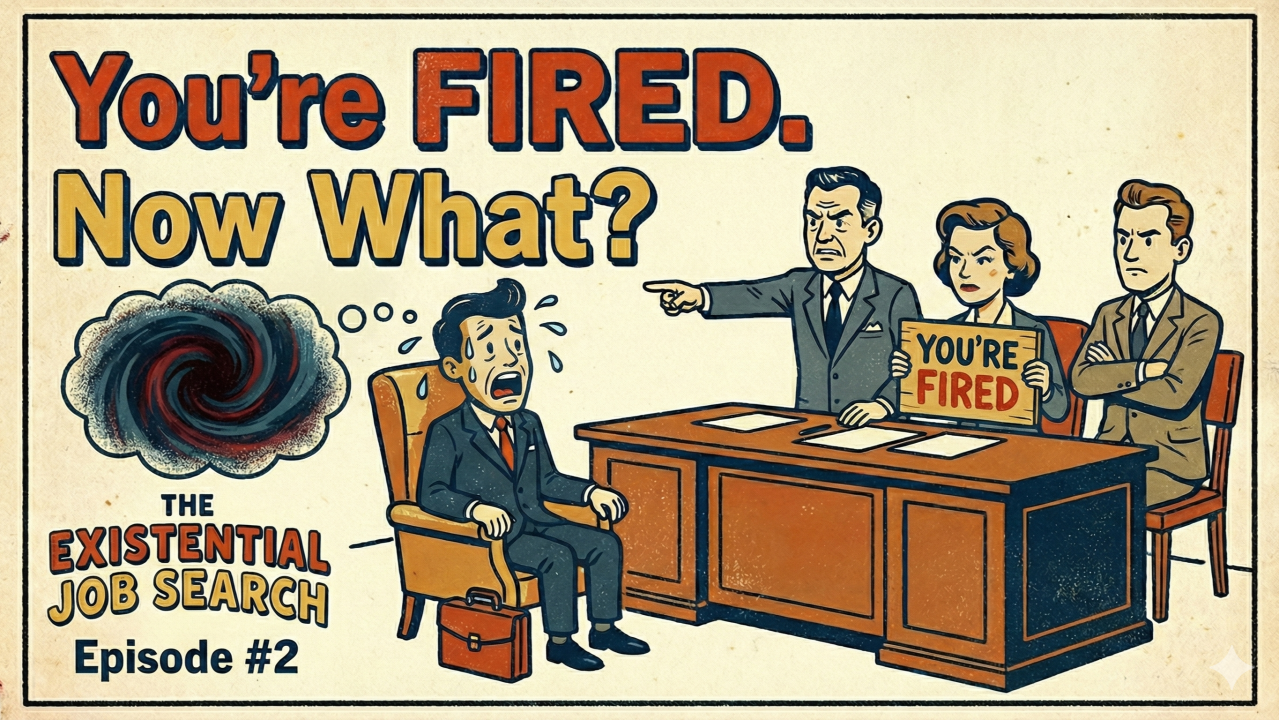
F*CK.
Let’s just get that out of the way.
Because that is the only appropriate, honest, and universally understood response to the moment it happens.
The moment your boss, or HR, or some random person you’ve never seen before, says the words.
“We’ve decided to go in a different direction.”
(Which, by the way, is corporate speak for: "We've decided to save 15% on your salary and give your job to a slightly cheaper, slightly more desperate person who will work 30% harder for 10% less. Nothing personal.")
It’s a punch to the gut that doesn't just hurt your wallet.
It hurts your identity.
It’s a seismic event that rearranges your entire self-worth.
You are now officially a member of the Existential Job Search Club. (Welcome. We have lukewarm coffee and crippling self-doubt.)
The Shockwave: From Panic to Existential Dread
The initial wave is pure, unadulterated Panic.
It’s the frantic, directionless scramble. You are in the Bargaining Stage of grief, and it’s the most dangerous.
What’s next? Will I find a job? Can I keep the house? What will my friends think about me?
You are so desperate to stop the pain that you are willing to jump into a job that will make you miserable in six months.
You start applying for jobs you know you will actively hate.
Then you find nothing.
You lower your salary expectations. You tell recruiters you're "flexible" (which is code for "I will do anything for money, please just make the 3 AM dread stop").
Stop.
Take a breath. Go stare at the ceiling for a minute.
The problem isn't that you're unemployed.
The problem is that you're trying to solve an existential crisis with a transactional solution.
You are trying to find a job title. You should be trying to find direction.
The only way out of the panic is to find Orientation. You need to figure out your internal compass before you start navigating the external world.
The Three Types of Unemployed (And Why We're All Equally Miserable)
We need to acknowledge that not everyone here got fired. The shame is different, but the panic is the same.
- The Fired: You were told you weren't needed. That what you spent years to refine can be done, cheaper, and better by a guy with a strange accent in a shack thousands of kilometers away, or even worse, by AI.
The identity crisis is immediate and brutal.
You feel like damaged goods. You are convinced your former employer is telling everyone you were terrible. You are grieving the loss of your title, your team, and your routine. Y
You are the victim of a corporate breakup, and you're currently eating ice cream in your pajamas.
- The Quitter: You left on your own terms. You were a hero. You had a plan. You told everyone you were "pursuing other opportunities" (corporate speak for "I had enough of this sh*t.").
Then the job market laughed in your face.
Now you have the quiet, internal shame of leaving a perfectly good job for… this. Nothing.
The regret is the silent killer: "I should have just stayed." You are the person who broke up with the company, only to realize you have nowhere to sleep.
- The Entrepreneur: You are "working on a project." Or you are "building your brand." (Which is code for: "I have no income, but I have a very cool personal website and a lot of free time to make sourdough.")
Or, as someone once told me, “ ‘Projects’ are for people who can’t get a job”.
You are trying to turn your unemployment into a badge of honor, but the panic is that the "project" is just a placeholder to make yourself feel a little less miserable.
In all three cases, the panic is the same. It's the fear of the unknown, the fear of being exposed as a fraud, and the fear that you'll never work again.
As one friend who was in this situation told me recently: “It fcks with your brain.”*
The Silent Killer: Shame and Identity Loss
This is the part nobody talks about in those insufferable "5 🚀 Tips to a Better Resume 🤩💪🏼" articles you see all over the place here. Because those articles are written by people who are still employed and think they are better than you.
The Shame.
It's not about the money. You can budget. You can cut back. At least for a while, until that becomes an additional icing on the panic cake.
The shame is about the identity.
You are a high-performer. You are the person who solves problems, who leads teams, who gets things done. You are the person who ties their entire self-worth to their job title.
You are a human doing, not a human being.
The loss of the job is the loss of the self.
You feel like damaged goods. You are convinced that everyone knows. You start avoiding social gatherings because the question "So, what do you do?" is now a loaded weapon. You consider lying and saying you're a "consultant" (which is code for "unemployed, but with a better vocabulary").
The High Performer's Trap:
You are trapped by your own success. You believe that admitting you are unemployed is admitting failure. You believe that asking for help is a sign of weakness. You believe that if you just work harder, the job will magically appear.
(Spoiler: It won't. The universe doesn't care about your work ethic.)
This is the Silent Killer. It keeps you isolated, paralyzed, and stuck in the Depression stage of grief.
The Secret:
The shame is a lie.
It's a societal construct.
The only way to beat it is to separate your value from your title. Your value is not your job. Your value is your unique ability to solve a specific problem. (And no, your value is not "Proficient in Microsoft Excel." We covered that last week.)
The Anti-Networking Guide: The High Performer's Dilemma
When you're trapped in the Shame and Panic, everyone tells you to "network."
That is terrible, terrible advice coming from people who are not in your situation.
You are emotionally exhausted.
You are in the Anger/Depression stage.
You’re ashamed.
The last thing you need is to put on a fake smile and have a "coffee chat" with a stranger who will ask you, "So, what are you looking for?"
A JOB, YOU MORON! THAT’S WHY WE’RE SITTING HERE!
The Problem with Traditional Networking
For the high-performer, traditional networking when unemployed is a special kind of torture:
- Exposure: It requires exposing vulnerability and admitting failure. You have to say, "I'm looking," which feels like saying, "I failed." You'd rather chew glass.
- The Ask: It feels like begging or a transactional exchange, which is anathema to a high-performer's self-image. You hate the idea of being a burden. You're the one who usually gives the advice, not asks for it.
The Solution: Internal Reflection as Anti-Networking. The only person you need to talk to is your own brain. (And maybe a therapist. But mostly your brain.)
The goal of this stage is internal reflection, not external validation. You need to figure out your direction before you start rowing.
Here is how to stop the panic and start the process of self-discovery:
1. The "Anti-Networking" Rule: No Coffee Chats for 30 Days
Your job for the next month is to network with your own brain.
Every time you feel the urge to "reach out" to a former colleague, stop. Instead, open a blank document and write down the answer to these three questions:
- What did I hate about my last job? (Your "Hate List" – the non-negotiable boundaries. Be specific. Did you hate the endless meetings, or just the pointless ones? Did you hate the work, or the person you did the work for? The more specific your hate, the clearer your direction. This is the map to your next happy place.)
- What did I do that felt effortless? (Your "Superpower" – the thing you do better than everyone else, without even trying. This is not "Proficient in Excel." This is "I can take a mess of disorganized data and make it clean while listening to a podcast." This is your true, marketable value. It's the thing you'd do for free, but thankfully, people will pay you for it.)
- What problem do I actually want to solve? (The core of your value, not your job title. Do you want to solve the problem of "people not understanding complex things," or the problem of "slow, inefficient processes"? This is the mission that will get you out of bed.)
If you can't answer these questions, you have no business asking a stranger for a job. You're just asking them to solve your existential crisis for you. (And they will charge you for it.)
2. The LinkedIn Blackout: Your Profile is a Liar
Your LinkedIn profile is a chronological list of places you worked and things you were told to do. It’s a document of your past, not a map of your future.
It's a beautiful, curated lie.
Stop looking at it.
When you're in the panic stage, you look at your profile and think, "I must find a job that looks exactly like this, but with a better salary."
This is how you end up in the same miserable job, just with a different logo on your laptop.
Instead of spending hours tweaking keywords, spend 30 minutes writing down the three things you are most proud of that no one at your last job ever noticed. Those are the clues to your next direction. (Mine was "I once fixed the office coffee machine with a paperclip and a sheer force of will." That's a problem-solver, baby.)
3. The Reverse Resume Mindset: What You're Really Selling
We'll dive deeper into the Reverse Resume next week, but for now, adopt the mindset:
Your value isn't your title; it's your unique ability to solve a specific problem.
The old way: "I am a Senior Marketing Manager." The new way: "I solve the problem of 'nobody is clicking our ads' by being a Human Lie Detector for bad copy."
If you don't know what problem you solve, you're just a generic applicant. And generic applicants, as mentioned in the last episode, get eaten by the Applicant Tracking System.
Stop trying to prove you're worthy of the old job. Start proving you're the only person who can solve the next problem.
IV. The Path to Acceptance: Turning F*CK into FOCUS
The most important step is to move from Panic and Shame to Acceptance.
Acceptance isn't about being happy you were fired. It's about accepting that the old path is closed, and you now have a blank slate.
You need a structured way to get to that acceptance. You need a way to quickly identify your Superpower and your Hate List so you can stop the frantic, directionless applying.
You need a way to turn the F*CK into FOCUS.
This is the part where you realize the existential dread is actually a gift. A terrible, unwanted, deeply inconvenient gift.
- The Gift of the Hate List: You now have a legally binding document that says, "I will never attend a meeting that could have been an email again." This is more valuable than any severance package.
- The Gift of the Superpower: You've identified the one thing you're truly great at. Now you can stop pretending to be good at everything else. You are a specialist, not a generalist. You are a scalpel, not a butter knife.
- The Gift of the Blank Slate: You are free. You can now build a career that is actually aligned with your values, not just your mortgage payment.
The only thing standing between you and your next, better job is 30 minutes of honest self-reflection.
You need a way to quickly and brutally assess your skills and desires without the bias of your old job title. You need a tool that can take your panic and turn it into a personalized, actionable map.
That’s how you beat the existential dread.
That's all for this week.
Go forth and be slightly less miserable in your job hunt.
Rob
(This issue of The Existential Job Search was brought to you by UniqU, the platform designed to help you find a job. There's a 30-minute onboarding process designed to cut through the noise and help you identify your core strengths and boundaries, so you can skip the bargaining stage and jump straight to acceptance. After that, UniqU will create one-click application letters and resumes that kick ass and well help you ace those interviews with realistic interview preparation. Try UniqU for free here and find your direction.)