
The Existential Job Search: Issue #3
If you’re reading this, congratulations. You survived another week of unemployment without resorting to a multi-level marketing scheme. That’s a win.
Last week, we talked about turning the "F*CK !!!" moment of job loss into FOCUS by finding Orientation. We established that the only way out of the panic is to stop applying for jobs you hate and start figuring out what you actually want.
This week, we’re giving that focus a weapon so sharp it could cut through a corporate mission statement.
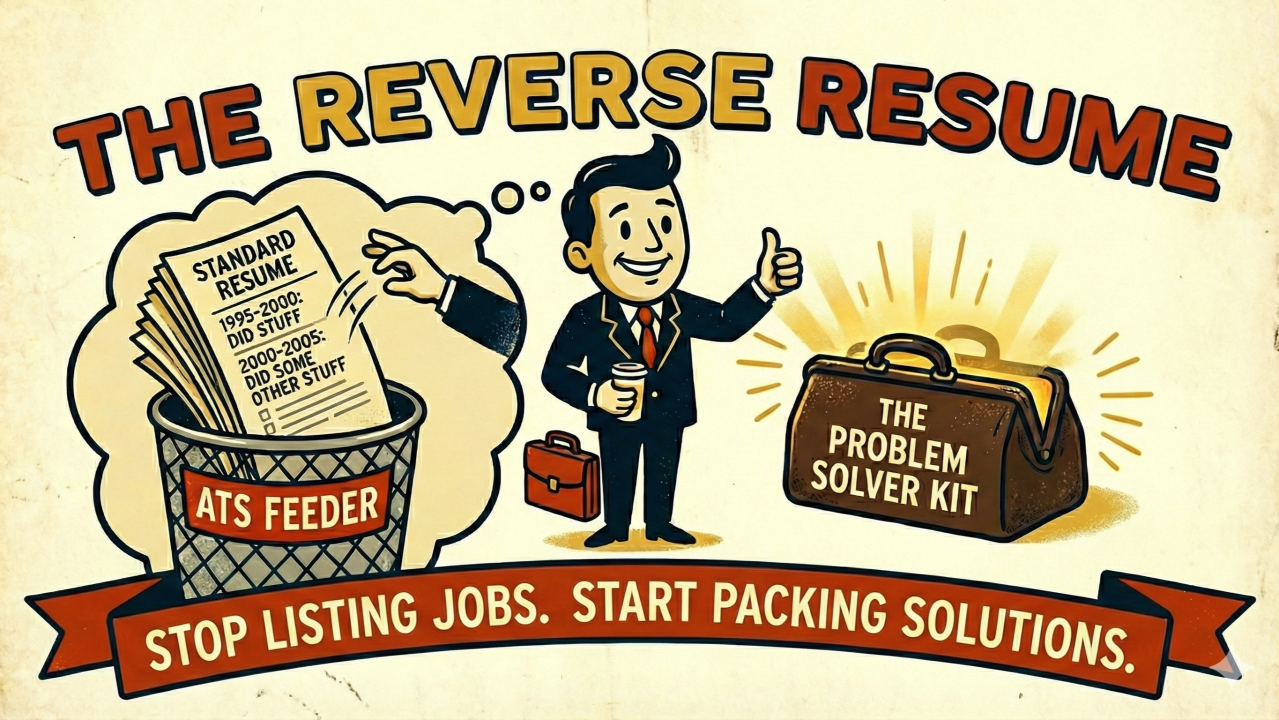
We’re talking about the Reverse Resume.
I. The Lie of the Traditional Resume
Let’s be honest. Your traditional resume is a beautiful, curated lie.
It’s a chronological list of places you worked and things you were told to do. It’s a document of your past, not a map of your future. It’s a generic key that fits no lock, a historical artifact that proves only one thing: You can follow instructions.
It’s a document designed to make you look like a perfectly interchangeable cog in a perfectly interchangeable machine. And you wonder why you’re not getting calls back?
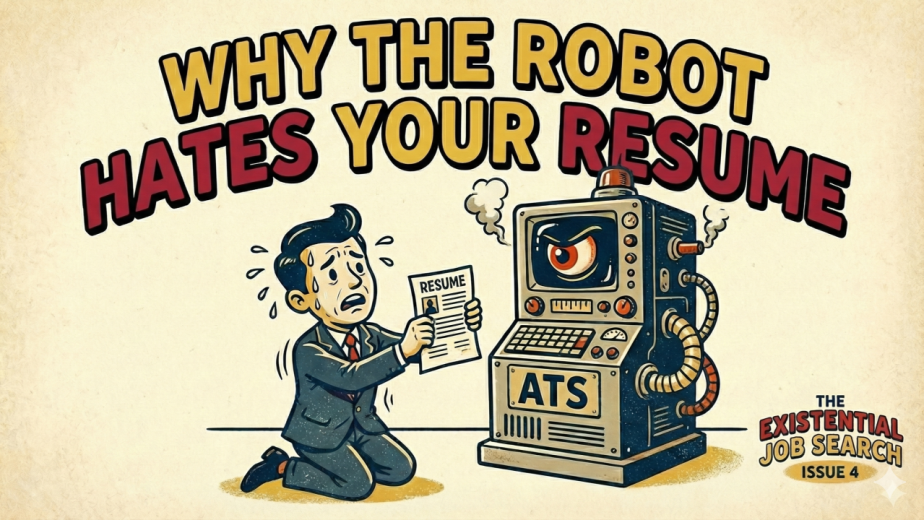
The traditional resume is what happens when you try to solve an existential crisis with a Microsoft Word template. It’s useless. It’s boring. It’s what gets eaten by the Applicant Tracking System (ATS) and then immediately forgotten by the human who eventually scrolls past it.
The Core Thesis: Your value isn't your title; it's your unique ability to solve a specific problem.
The Reverse Resume is the document that proves it.
II. The Reverse Resume: A Document of Value
The Reverse Resume is not a document you send to a recruiter. It’s a document you write for yourself. It’s the brutal, honest truth about what you’re good at and what you hate.
It’s a document organized by the problems you solved and the energy you gained from solving them.
We’re going to organize it into three columns. Grab a piece of paper, or open a blank document.
(No, not your old resume. Close that tab. It’s dead to us. It’s currently being used as a coaster for my tears.)
The Three Columns of Truth
Column 1: The Problem (The actual, painful problem that existed before you showed up.) Column 2: The Solution/Superpower (What you did, framed by your unique ability.) Column 3: The Result/Energy (The measurable outcome and the feeling it gave you.)
This document is your internal compass. It’s the map to your next happy place.
III. Deep Dive: Column 1 – The Problem (The Hate List Revisited)
Why are job descriptions useless? Because they list tasks, not problems.
They say things like: "Seeking a dynamic self-starter to leverage synergies and drive cross-functional collaboration."
Translation: "We have no idea what we're doing, and we need a desperate person to attend pointless meetings and make it look like we do. Also, we use the word 'synergy' unironically, and we're pretty sure the CEO thinks 'leveraging' is a yoga pose."
The only way to find the real problem you want to solve is to look at your Hate List (from Issue #2 of this Newsletter). The things you hated in your old job are the problems you don't want to solve.
The Reframe: Every task you did was a solution to a problem. You now need to reverse-engineer the problem from the task.
The Problem: Reverse-Engineering the Lie
We need to start reverse-engineering the lies and finding the truth behind them. Here's an example:
- The Task (The Lie): Managed the company's social media accounts.
- The Problem (The Truth): The company was invisible online and losing customers to competitors who actually knew how to use the internet.
Got it?
- The Task (The Lie): Wrote quarterly reports.
- The Problem (The Truth): The leadership team was making decisions based on gut feelings and outdated information, and needed someone to turn a mountain of data into a single, actionable sentence.
The problem is the pain. If you can identify the pain, you can identify the job. Stop looking for a title. Start looking for a company that is bleeding from a problem you know how to fix.
IV. Deep Dive: Column 2 – The Superpower (The Effortless Win)
This is the hardest column for high-performers. Why? Because it feels too easy.
You think: "If it's easy for me, it must be easy for everyone." Lie.
That thing you do that feels like "cheating"? That thing you do when you're procrastinating on something else? That thing people always ask you for help with? That is your superpower.
It’s the thing you do better than everyone else, without even trying. It's the thing that makes you a specialist, not a generalist.
The Superpower Test:
-
The "Cheating" Moment: Think of a time at your last job where you solved a massive problem in 10 minutes, and everyone else had been struggling for a week. That was your superpower. (Mine was fixing the printer by yelling at it. It worked every time. I am a Printer Whisperer.)
-
The Procrastination Project: What do you do when you're supposed to be doing something else? Do you organize your spice rack? Do you build a complex spreadsheet for your fantasy football league? That obsessive focus is your superpower. (If you're building a complex spreadsheet for fun, you are a Data Sadist and companies will pay you handsomely for your sickness.)
-
The Language Shift: Stop using generic skills. Start using unique abilities.
The Superpower: Translating the Lie
Let's look at some examples:
- Generic Skill (The Lie): "Project Management"
- Unique Ability (The Superpower): The ability to create order out of chaos, even when the chaos is caused by people who are actively trying to create more chaos.
or
- Generic Skill (The Lie): "Attention to Detail "
- Unique Ability (The Superpower): The ability to see the one critical flaw in a plan that everyone else missed, saving the company from a very expensive, very public mistake.
or
- Generic Skill (The Lie): "Communication Skills"
- Unique Ability (The Superpower): The Translator who can take a complex engineering concept and explain it to a five-year-old (or a CEO).
or
- Generic Skill (The Lie): "Leadership"
- Unique Ability (The Superpower): You're the one person in the room who is willing to tell the CEO their idea is terrible.
Your superpower is what makes you a scalpel, not a butter knife. It's what makes you indispensable.
V. The Application: Turning the Reverse Resume Forward
Now you have your document of truth. How do you use it?
Stop searching by title.
Start searching by Problem.
-
Identify the Problem: Look at your Reverse Resume. Which problems did you solve that gave you the most Energy? That's the problem you want to solve next.
-
Find the Bleeding Company: Search LinkedIn, job boards, and news sites for companies that are publicly struggling with that exact problem. (e.g., If your superpower is "fixing messy data," search for companies that just announced a merger – there's nothing more messy than integrating two companies messy tools and data structures. Ewww.)
-
The Cover Letter Hack: The Reverse Resume becomes your cover letter. Instead of saying "I am a good fit," you say, "I see you have Problem X. I have solved Problem X before using Superpower Y. Here is the result."
You are no longer a generic applicant. You are a Problem-Solving Specialist. You are a surgeon walking into a room full of people with a very specific, painful ailment.
VI. Conclusion: The Blank Slate is Your Weapon
The traditional resume is a document of fear. The Reverse Resume is a document of power.
The only thing standing between you and your next, better job is 30 minutes of honest self-reflection.
You need a way to quickly and brutally assess your skills and desires without the bias of your old job title. You need a tool that can take your panic and turn it into a personalized, actionable map.
The Final Word on Your New Resume:
You are free. You can now build a career that is actually aligned with your values, not just your mortgage payment.
You've identified the one thing you're truly great at. Now you can stop pretending to be good at everything else.
And best of all? You now have a legally binding document (the Hate List) that says, "I will never attend a meeting that could have been an email again." This is more valuable than any severance package.
That’s how you beat the existential dread.
What's next is, finding the right companies that need your exact skillset – that's what I'll talk about in the next edition.
That's all for this week.
Go forth and be slightly less miserable in your job hunt.
Rob
(This issue of The Existential Job Search was brought to you by UniqU, the platform to help you find a job, fast. Our 30-minute onboarding process is designed to cut through the noise, build your Reverse Resume and help you identify your core strengths and boundaries, so you can skip the generic application process and start applying as a Problem-Solving Specialist.
Try UniqU for free here and find your direction. 10% off for LinkedIn members.)