
The Existential Job Search: Issue #4
Welcome back to the Existential Job Search. I hope your internal compass is still recalibrating, and you’ve accepted that your Reverse Resume (that we created last week) is a document of truth for you, and only you.
Now, for the next stage of the corporate Hunger Games. You’ve done the self-reflection. You know your Superpower. You’re ready to apply.
You hit "Submit" and wait. And wait. And then, a week later, you get the polite, automated rejection email:
"We went in a different direction."
What direction? Well, the direction that doesn't involve YOU.
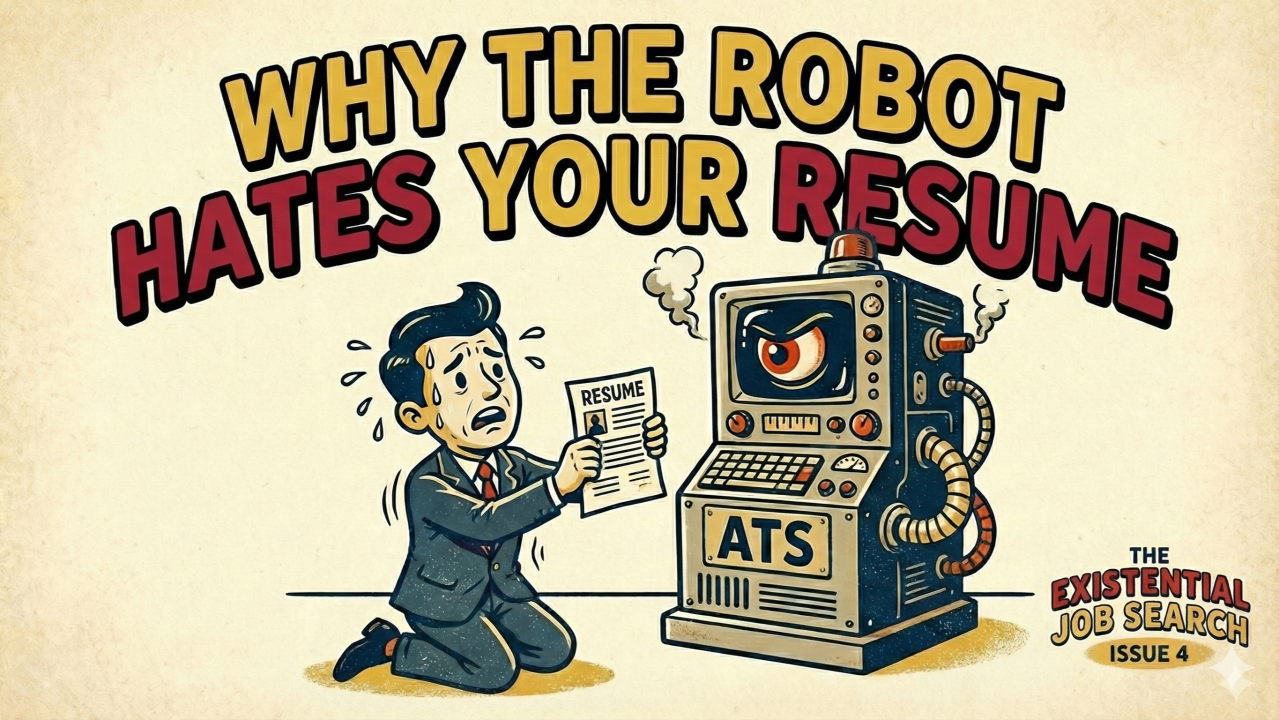
The problem isn't your qualifications. The problem is the first, most powerful, and most boring gatekeeper in the world: the Applicant Tracking System (ATS).
The ATS is why your resume, a document you poured your soul into, is currently being used as digital confetti. It’s why you’re being ghosted by a machine.
I. The ATS Anatomy: Why It Hates You
The ATS is not a person. It is a toddler with a checklist. It is a literalist. It doesn't understand context, your smart irony, or your crippling self-doubt. It only understands data fields.
The biggest lie in the job search is that the process is fair. It’s a game, and the ATS is the first level. If you don't follow the rules, you get a polite rejection email that says, "We went in a different direction," which is corporate speak for "The robot didn't like your font, and you didn't use the word 'synergy' enough times."
The Formatting Massacre: The Boomer Who Hates Your Art
You spent hours on your resume. You used a sleek two-column template from Canva. You added cute little icons and those trendy "skill bars" to show off. You used a custom font that screams "creative professional." Boy, does your resume look modern and sleek. You're incredibly proud of yourself.
The ATS sees none of it.
When you upload your beautiful, curated lie, the ATS strips it bare. It throws out the columns, scrambles the icons, and turns your custom font into a garbled mess of text. It’s a boomer who only understands Times New Roman and chronological order. It's the corporate equivalent of a VCR that refuses to play your Blu-Ray.
The Rule: The ATS only reads plain text. Your beautiful design looks like a corrupted file. Formatting is for humans. The robot only wants keywords.
The Literal-Minded Toddler: Why "Managed" is a Death Sentence
The ATS doesn't understand your soul, your context, or your crippling self-doubt. It only understands data fields. While the modern ATS is trying to be sophisticated, it is still a machine that operates on the most literal, basic level. It's the most literal-minded date you've ever been on, and you must assume it has the intelligence of a slightly damp sponge.
Example 1: The Verb Trap.
You wrote: "Managed a team of five." The ATS is looking for: "Supervised five direct reports." Result: The ATS gives you a low score. You could have managed the entire company, solved world hunger, and taught a cat to play the piano, but if you didn't use the exact verb the ATS is looking for, you're a zero, not a hero. The ATS is not impressed by your piano-playing cat.
Example 2: The Acronym Trap.
You wrote: "I have extensive experience with JS." The ATS is looking for: "I have extensive experience with JavaScript." Result: The ATS flags you as missing a key skill. Even though modern systems are getting smarter (semantic matching), you should never trust a robot with your career. Spell it out. The robot is not a mind-reader, it's a glorified spell-checker.
II. The Keyword Decryption: How to Make It Love You
The job description is not a wish list; it's the ATS's answer key. We're going to stop trying to impress the robot and start trying to satisfy its programming.
The Three Decryption Layers
The ATS is not a simple word counter anymore. Modern systems are sophisticated, but still easily gamed. They score your resume based on three layers:
- Layer 1: The Literal Match (Keywords):
You must find the exact keywords the job description uses and mirror them. If they say "synergy," you say "synergy." If they say "dynamic self-starter," you are now a dynamic self-starter. The Sarcastic Truth: You don't have to be a dynamic self-starter. You just have to say you are. (But don't lie outright, of course. If you hate cooking, maybe don't apply as a chef.) The ATS is a literalist. Give it the keywords, and it will let you pass.
- Layer 2: The Semantic Match (Synonyms):
This is where the ATS tries to be smar, but sometimes it fails. It understands that "JavaScript" and "JS" are the same thing, in theory… but not always. Your job is to hedge your bets. Use BOTH the formal and informal terms where appropriate. The Rule: If you have the space, use the full term once, and the acronym once. Never trust the robot's intelligence.
- Layer 3: The Structural Scorecard:
The ATS is looking for a specific career narrative: Job Titles, Years of Experience, and Education. If the job requires 5 years of experience, the ATS is literally counting the dates on your resume. The Rule: Make sure your resume clearly and cleanly displays this chronological data. No gaps. No ambiguity. The ATS is a stickler for the rules.
The Ultimate Cheat Code: The "Mirroring" Technique
The "white font" trick you sometimes hear people mention (keyword-stuff your resume with white font on white background) is desperate and risky. We're better than that. We're going to use a more ethical, but slightly cynical, technique: Mirroring.
The Problem: You can't fit all the keywords into your resume without sounding like a maniac. The Solution: Take the "Requirements" section of the job description. Rewrite those bullet points exactly as they appear, but integrate them naturally into your experience section. The Result: The ATS sees a 90%+ match because you've mirrored its language. The human sees a resume that is perfectly tailored to the job.
You've satisfied the robot without resorting to forgery.
III. The ATS-Proof Resume: The Manual Labor You Hate
You know what you need to do. You need to tailor your resume for every single job. You need to manually decrypt every job description. You need to spend an hour on a document that a robot will spend 10 seconds scanning.
This is the tedious, soul-crushing manual labor that makes the job search feel like a punishment.
(There are tools that can help you, more about that later, but it's important that you understand what's happening, first)
The Three-Step Manual Grind
This is how you beat the ATS without a tool. This is the penance you pay for not being a robot.
- The Decryption Spreadsheet:
Open a spreadsheet. For every job you apply to, paste the job description into one column. In the next column, manually highlight and extract every single keyword, acronym, and required skill. In the third column, manually check your resume against that list. Highlight every word on your resume that matches the job description. If less than 80% is highlighted, you have failed. Sarcastic Angle: This is the most boring spreadsheet you will ever create. It is the corporate equivalent of counting grains of sand. But it works.
- The Structural Sanity Check:
Manually verify that your resume clearly shows the required years of experience. The ATS is not going to do math. If the job requires "5+ years of management experience," you need to ensure the dates on your resume add up to 60+ months. The Rule: If the ATS has to think, you lose. The ATS is not paid to think.
- The Final Plain Text Test:
Copy your entire resume and paste it into a plain text editor (like Notepad or TextEdit). If it looks like a clean, readable document, you're safe. If it looks like a ransom note written by a drunk alien, you have failed the formatting test. The ATS is a simple creature. Do not confuse it.
IV. Conclusion: The Final Word on the Robot
You now have the tools to beat the biggest gatekeeper in the modern job search: the ATS.
The only thing standing between you and your next, better job is a willingness to game the system.
The Final Word on the Robot Overlords:
Give the robot the keywords, the structure, and the confident tone it demands. The ATS is a necessary evil. We don't fight it; we exploit its weaknesses.
That’s how you beat the existential dread.
V. Next Week: The AI Interview
You've tricked the ATS. You've made it past the first filter. Now you face the next boss: the AI Interviewer. (This job search is starting to get quite tedious, eh?)
So next week, we're dedicating the entire issue to the automated video/voice interview: "The AI Interview: How to Beat the Bot and Sound Like a Human."
We'll talk about the STAR method, the confidence trick, and how to make sure the robot hears a perfectly rehearsed corporate drone, not a rambling lunatic.
Don't miss it.
That's all for this week. Go forth and be slightly less miserable in your job hunt.
If this article saved you from throwing your laptop out the window, please share it with one other person who looks like they’re about to throw their laptop out the window. Fresh thinking spreads only when we help it travel.
Rob
P.S. This issue of The Existential Job Search was brought to you by UniqU. UniqU automates the boring, robotic parts of the job search so you can focus on being human. Uniqu's Resume Optimizer helps you translate your resume into the language the robots demand. Heck, it even rewrites your resume for a specific job – to give you a perfect ATS match score. With one click, and not with sweat and tears. It's like magic. Seriously.
Try UniqU for free here and save yourself hours of wasted time.