

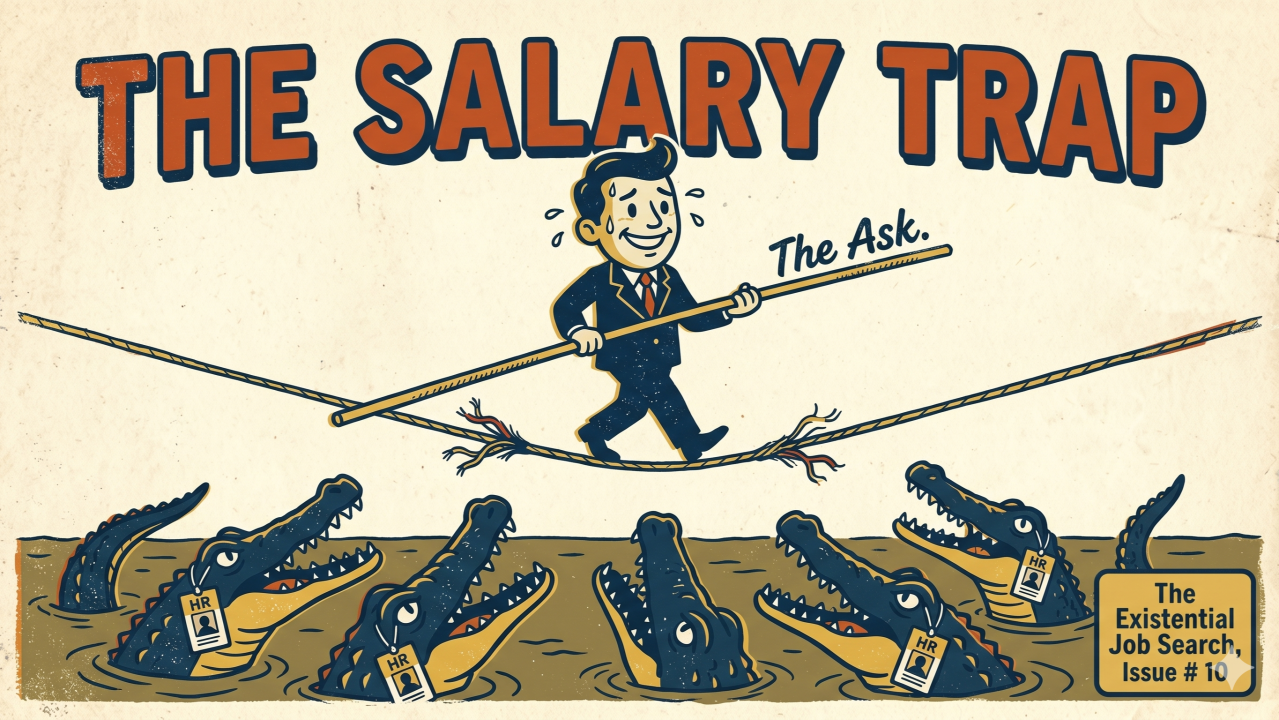
The Existential Job Search: Issue #10
I. Introduction: The Moment Your Worth Becomes a Negotiation
There is a specific, cold dread that sets in at the end of a long job search. You’ve spent weeks – maybe months – proving your competence to strangers. You’ve survived the digital gauntlet of application portals, charmed the gatekeepers, and navigated the multi-round interview marathon. You are at the finish line. You can almost taste the relief of a steady paycheck and a new beginning.
Then comes the call – or these days, the Zoom link. The one where the HR representative appears on your screen with a background of tasteful houseplants and a smile that feels a little too practiced. They lean in, head tilted in a gesture of performative empathy, and say, with a voice dripping with manufactured camaraderie, "We're really impressed. We think you'd be a great fit. We're so excited to have you join the family! So, just between us, what are your salary expectations?" Or, even more insidiously, "What's your ask?"
In an instant, the "family" vibe evaporates. You realize that despite the weeks of "getting to know you," you are now in a high-stakes interrogation. This is the verbal ambush – the moment where the company tries to get you to name a number first so they can anchor your value as low as possible. It’s the final act of psychological warfare in the job search, and if you blink first, you could be leaving tens of thousands of dollars on the table.
This issue is your survival guide for the most dangerous conversation in your career. We’re going to decode the corporate doublespeak, expose the "friendly HR" tactics, and arm you with the exact scripts to demand your worth without sounding "ungrateful" for the "opportunity."
Because in this game, the first one to name a number often loses. If you've ever felt the sting of a lowball offer or the awkwardness of a "friendly" HR call, this is for you. Welcome to the final act of the job search.
II. The "Best Friend" Trap: Manufactured Empathy on Camera
Before we get to the numbers, we have to talk about the medium. In the age of remote work, the negotiation has moved from the mahogany boardroom to the 13-inch laptop screen. This has given HR a new, lethal weapon: The Manufactured Empathy Trap.
- The Performance of Warmth
On a video call, HR isn't just a gatekeeper; they are playing the role of your "advocate." They’ll use "active listening" cues – the constant nodding, the "mm-hmm" of agreement, the mirroring of your body language – to create a false sense of intimacy. They want you to feel like you’re "just chatting" with a friend. Why? Because friends don't drive hard bargains. Friends don't demand an extra $20k. Friends are grateful.
- The "Off-the-Record" Illusion
They might lean in closer to the camera, lower their voice, and say, "Look, I’m on your side here. I want to get you the best deal possible, but I need a number to take back to the team. Just give me a ballpark so I can start the fight for you."
The Reality: They are not on your side. They are on the company's side. This "off-the-record" moment is a data-mining expedition. Any number you give "just between us" will be the absolute ceiling of the formal offer. They aren't "fighting" for you; they are trying to find the lowest number you won't be insulted by.
- The Mirroring Menace
If you seem hesitant, they’ll mirror your concern. "I totally get it, it's a big decision. I've been there too!" This is designed to make you feel guilty for being "difficult." They are leveraging your human desire for social harmony to make you settle for less.
The Counter-Strategy: Maintain the "Professional Wall." Be polite, be warm, but remain strategically opaque. Treat the video call like a televised press conference, not a coffee date. Your goal is to be "likable but expensive."
III. The Psychology of the Lowball: Why They Do It (And How to Exploit It)
Before we dive into the specific tactics, it’s crucial to understand why companies lowball. It’s not always malice; it’s often a calculated risk-mitigation strategy, driven by a complex interplay of internal politics, budget constraints, and a deep-seated fear of setting a precedent. Understanding their motivations is your first step to dismantling their arguments.
- The Blame Committee Mentality: Spreading the Risk
Remember the "Blame Committee" from Issue #8? They’re back, and they’re just as risk-averse. No one wants to be the person who approved an "overpaid" hire. By starting low, they protect themselves. If you accept, great – they saved money. If you negotiate, they can always say, "We tried our best, but the candidate pushed back." It’s about diffusing individual accountability for a higher spend. Your leverage comes from making it more painful for them to lose you than to pay you.
- The Budgetary Illusion: Fixed vs. Flexible
Companies always have a budget. But budgets are often more flexible than they appear, especially when a critical role needs to be filled. The "maximum" they quote is often a soft maximum, designed to be tested. They operate on the assumption that most candidates won’t negotiate, or won’t negotiate effectively. Your job is to prove that assumption wrong. They have money; they just don’t want to spend it on you unless they absolutely have to.
- The Desperate Hiring Manager: Your Secret Weapon
While HR is often the gatekeeper of the budget, the hiring manager is usually desperate. They have a problem that needs solving, a team that’s understaffed, and a looming deadline. Every day the position remains unfilled is a day they’re doing two jobs, or their team is burning out. This desperation is your most potent weapon. HR wants to save money; the hiring manager wants a solution. Your negotiation isn’t just about money; it’s about solving their problem faster and more effectively.
- The "Precedent" Panic: Fear of Internal Imbalance
Companies often fear setting a precedent by paying a new hire significantly more than existing employees. This isn’t about fairness; it’s about avoiding awkward conversations and potential internal unrest. They’d rather underpay you than deal with the fallout of an existing employee discovering they’re making less. Your counter-argument isn’t to demand they raise everyone else’s salary, but to demonstrate your unique value that justifies a higher compensation, making you an exception, not a precedent.
III. The Verbal Gauntlet: Deflecting "What's Your Ask?"
This is where the rubber meets the road. The moment they try to get you to name a number first. Your goal: do not name a number first. Or, if you must, do it strategically.
The Golden Rule: Never Be First (If You Can Help It)
Why? Because the first number mentioned becomes the anchor. If you go too low, you’ve set a ceiling for yourself. If you go too high, you risk scaring them off. Let them anchor first. It gives you valuable information about their budget and their perceived value of the role.
Counter-Script 1: The Information Gatherer
Their Question: "So, what are your salary expectations?" or "What's your ask?" Your Verbal Counter: "That's an excellent question, and I'm certainly looking for a compensation package that reflects my experience and the value I can bring to this role. To ensure I provide a realistic figure, could you share the budgeted range for this position? It would help me understand if we're aligned." Why it works: It politely deflects, puts the ball back in their court, and frames your request as a desire to be "realistic" and "aligned." It also subtly implies that you have* an expectation, but you're being thoughtful about it.
Counter-Script 2: The Value Proposition (When They Won't Budge)
Their Persistence: "We really need you to give us a number first. What are you looking for?" Your Verbal Counter: "Based on my research into similar roles with my level of experience and the significant impact I anticipate making here at [Company Name] – particularly in [mention 1-2 key areas of impact relevant to the role] – I'm looking for a total compensation package in the range of [Your Well-Researched Range]. This includes base salary, bonus, and benefits. I'm confident that my contributions will quickly justify this investment." Why it works: You've named a number, but you've done so with context. You've tied it to your value and your research, making it sound less like a random demand and more like a well-considered investment. Your range should be ambitious but defensible. Always give a range, not a single number, and make the bottom of your range your actual* desired number.
Counter-Script 3: The Market Data Anchor (If You Have Strong Data)
Their Question: "What are your salary expectations?" Your Verbal Counter: "My understanding of the market rate for a professional with my [specific skills/experience] in this type of role, particularly in [this industry/location], is typically in the range of [Your Well-Researched Range]. I'm confident that my contributions will align with the higher end of that spectrum." * Why it works: You're not just pulling a number out of thin air; you're grounding it in objective market data. This makes your ask seem reasonable and informed, rather than arbitrary.
IV. The Negotiation Bridge: From Supplicant to Solution
Congratulations. They want you. This is the crucial moment where the power dynamic shifts. You are no longer begging for an interview; you are the solution to their problem. You are the missing piece. This transition from supplicant to solution is the foundation of effective negotiation. You are not asking for a favor; you are discussing the terms of a mutually beneficial partnership.
Your Leverage Points:
- Your Unique Value: What specific skills, experiences, or achievements do you bring that directly address their pain points?
- Market Data: What is the objective market rate for someone with your profile in this role and location?
- Alternative Options: Do you have other offers, or are you confident you can get them? (Even if you don’t, projecting this confidence is key).
- Their Urgency: How quickly do they need this role filled? A desperate hiring manager is a flexible hiring manager.
V. Decoding the Verbal Lowball: Real-Time Counter-Scripts
Here, we dissect their most common verbal lowball tactics and arm you with specific, tactical responses. Remember, these aren’t just words; they’re a performance. Deliver them with calm confidence, not aggression.
- "We have fixed salary ranges / salary bands for this level. The top of the range is [low number]."
What they mean: "We have a range, and we’re starting you at the bottom. The 'fixed' part is how much we don't* want to pay you. We're hoping you won't push back. And we're telling you the top of the range to make you think there's no more room."
Your Verbal Counter: "I understand the need for internal equity and salary structures. Given my unique experience in [specific skill/project], which directly addresses [company pain point], I believe my market value aligns with the higher end of that band, or even beyond for someone bringing my level of immediate impact. What flexibility exists for candidates who exceed the typical profile and bring immediate, measurable impact?"
- "We have 3 other candidates for this position, what can you offer us?"
What they mean: "We’re trying to create artificial scarcity and pressure you into accepting quickly. Also, we’re probably lying about the quality of those other candidates, or at least exaggerating their enthusiasm. Don't make us choose."
Your Verbal Counter: "That’s great to hear you have a strong pool of candidates. I’m confident that my [specific value proposition, e.g., 'proven ability to drive X results'] makes me the ideal fit. My expectation for a total compensation package remains in the [your desired range], which I believe is competitive for the value I bring. I’m excited about this opportunity and am happy to move forward once we align on compensation."
- "We'd like to start with a low salary and if you prove yourself, we can renegotiate."
What they mean: "We want to pay you less now, and we have no intention of renegotiating later. 'Proving yourself' is a moving target, and we’ll find a reason not to give you more. This is a red flag about how we value our employees."
Your Verbal Counter: "I’m confident in my ability to prove myself immediately. My track record at [previous company] demonstrates [specific achievement, e.g., 'exceeding targets by X% within the first 90 days']. Therefore, I’d prefer to start at a compensation that reflects the value I’ll be delivering from day one. What is the maximum you can offer to reflect that immediate impact?"
- "While the base is lower than your ask, the bonus structure, 401(k) match, and premium health benefits make this a much stronger offer overall."
What they mean: "We’re trying to distract you with shiny objects and benefits that are either standard, difficult to achieve, or not worth as much as actual cash in hand. Don't look at the base; look at the 'total package' illusion."
Your Verbal Counter: "I appreciate the comprehensive benefits package. To ensure I’m evaluating the total compensation accurately, could you provide a detailed breakdown of the bonus structure, including historical payout percentages, and the exact costs and coverage details for the health plan? My base salary expectation remains [your desired base] to meet my financial needs."
- "We have to keep salaries consistent with your peers already in the building. Bringing you in higher would create an imbalance in the team."
What they mean: "We want to pay you what we pay everyone else, even if everyone else is underpaid. Your value is secondary to our internal politics and budget constraints. Your negotiation is about your* value, not their existing pay structure."
Your Verbal Counter: "I respect the importance of internal equity. My understanding of the market rate for this role, with my specific experience in [X], is [Y]. I’m confident that my contributions will quickly justify this compensation, and I’m eager to contribute to the team’s success. What flexibility exists to align my offer with my market value?"
- "Your previous salary was inflated by the NYC market. In this region, $140k goes as far as $180k did there."
What they mean: "We’re trying to use geographic arbitrage to pay you less, even if your skills are global. We’re also assuming you’re financially illiterate and haven’t done your research. Your skills are not tied to a zip code."
Your Verbal Counter: "I’ve thoroughly researched the market rates for this role in this region, and my expectation of [your desired salary] is well within the competitive range for someone with my [specific skills/experience]. While I appreciate the cost-of-living comparison, my value to the company remains consistent regardless of location."
- "This is the absolute maximum the board/finance has approved for this requisition. There is simply no more room in the budget."
What they mean: "We’ve hit our internal budget ceiling, and we’re hoping you’ll just accept it. We’re also trying to make it sound like it’s out of our hands, so you don’t blame us. 'Maximum' is often a soft maximum."
Your Verbal Counter: "I understand budget constraints are a reality. If there’s no flexibility on base salary, what other components of the total compensation package could be adjusted? I’m open to discussing a signing bonus, additional equity, or a performance-based incentive structure to bridge the gap."
- "Having [Company Name] on your resume will open doors for the rest of your career. People take a pay cut just to get their foot in the door here."
What they mean: "We’re trying to pay you in 'prestige' because we don’t want to pay you in actual money. Your landlord doesn’t accept 'brand recognition' for rent. Prestige is a nice bonus, but it doesn’t pay the bills."
Your Verbal Counter: "I’m incredibly excited about the opportunity to contribute to [Company Name] and recognize the value of its brand. However, my compensation needs to reflect both the market value of my skills and my financial responsibilities. While prestige is valuable, it doesn’t directly impact my ability to [pay rent/save for future]. What can we do to align the financial offer with the value I bring?"
VI. The "Draft" Offer: Don't Mistake a Verbal for a Verdict
Even if you've successfully navigated the verbal gauntlet and they've given you a number, remember: it's not an offer until it's in writing. Treat any verbal figure as a draft or a proposal. This gives you time to reflect, research, and potentially come back with further refinements once you see the full package.
Your Verbal Response to a Verbal Offer: "That sounds very promising. I appreciate you sharing that. I'd love to see the full compensation package in writing so I can review all the details, including benefits, equity, and any other components. When can I expect to receive the formal offer letter?"
Why it works: It expresses enthusiasm while maintaining a professional distance. It also sets the expectation that you'll be reviewing the entire package, not just the base salary, and that you're not committing until you see it all on paper.
VII. Conclusion: Negotiate Your Worth, Not Your Gratitude
The verbal negotiation isn’t a casual chat; it’s a critical juncture. You’ve earned the right to discuss your compensation. And in a system designed to devalue you, negotiation is not just an option; it’s a necessity. Understand their game. Decode their language. And remember that the best negotiation comes from a place of confidence, not desperation. Don’t let them pay you in prestige, promises, or the phantom comfort of a "fixed band." Demand your worth.
Go forth, decode the verbal ambush, and demand the compensation you deserve.
Rob
P.S. Next Week: The Written Insult (The Offer Letter)
Teaser: You’ve navigated the verbal minefield. Now, the formal offer letter arrives. It’s supposed to be the culmination, but often it’s just another battleground. We’ll break down how to dissect the written offer, identify hidden traps, and leverage it for even more.
P.P.S. UniqU: Your Negotiation Co-Pilot
In the high-stakes game of salary negotiation, UniqU is your secret weapon.
Our AI-powered negotiation coaches help you craft your counter-scripts, practice your delivery, and anticipate their next move. We turn the psychological warfare into a strategic game you can win. From decoding benefits packages to identifying exploding offers, UniqU ensures you negotiate from a position of strength, not manufactured gratitude. Demand your worth. Check the link in the comments to try UniqU for free.