
The Existential Job Search: Issue #5
Welcome back to the Existential Job Search Club!
Happy New Year!!
I hope your holiday season was full of warmth and cheer, not only well-meaning advice from relatives who got their job in 1987 – with a handshake.
It’s January.
The air is thick with the stench of false hope and gym memberships that will be abandoned by February.
Everyone is resolving to "be better," "eat clean," and "finally learn to play the ukulele." These are the lies we tell ourselves to cope with the crushing reality of another year.
Your resolution is: to stop being unemployed. It’s the only honest one in the room, and unlike "dry January," it actually matters.
But here’s the truth about the January job market: it’s not a fresh start. It’s a fresh wave of corporate cynicism. The robots are back from their holiday break, they’ve been updated, debugged, and they are hungry. They are ready to filter out anyone who can’t follow basic instructions.
The biggest lie of the New Year is that a fresh start means a fresh mind. You still have to play the game. We’re going to give you the one skill you need to survive the January surge: the ability to satisfy the AI interviewer.
Think of it as your first, and most important, resolution for the year: Mastering the art of corporate ventriloquism.
I. The Robot Handshake: How the ATS and AI Work Together
Before we talk about the AI Interviewer, we need a quick recap to tie this existential mess together. We've talked about the emotional rollercoaster of the job search (Issue #2), the sheer volume of applications you have to submit (Issue #3), and how the ATS (Applicant Tracking System) is a literal-minded toddler who only understands Times New Roman and keywords (Issue #4). You've done the emotional work, you've done the volume work, and you've learned to appease the toddler.
But here’s another truth: The ATS and the AI Interviewer are dating. (Okay that sounds a little weird, given the toddler analogy…) – anyway, they share notes.
The Data Handoff: The Corporate Gossip
When you pass the ATS, it doesn't just send your resume to a human. It sends a scorecard. This scorecard is corporate gossip, and it tells the AI exactly what to look for.
-
The Keyword Compliance Score: The ATS tells the AI how many keywords you used and how well your resume matches the job description.
-
The Structural Integrity Score: The ATS confirms you have the right years of experience and job titles.
-
The Risk Factor: The ATS flags any gaps in employment or formatting issues.
The Result: The AI Interviewer doesn't start from a neutral position. It starts with a bias based on the ATS's report.
If your ATS score is low, the AI is already listening for signs of rambling, uncertainty, and a lack of structure.
You are guilty until proven compliant.
II. The AI Interviewer: The Voice of the Machine
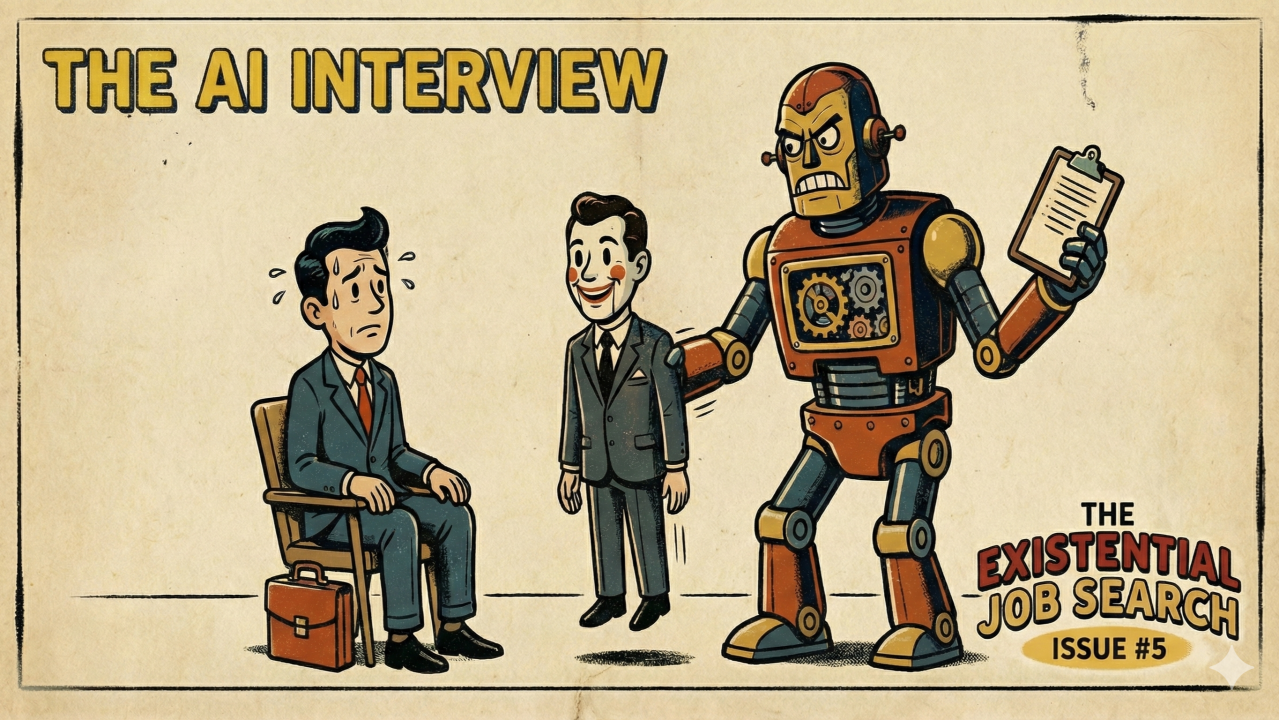
You beat the ATS (the toddler). Congratulations. Now you face the AI Interviewer (the literal-minded date).
This is the automated video or voice interview. You're talking to a camera, a microphone, and a very sophisticated algorithm that is judging you. The most common systems are from companies like HireVue, Talview, and Pymetrics.
You'll recognize them immediately: it's a link in an email, you click it, and suddenly you're staring at your own face on a screen with a timer ticking down. This is the one-way video interview, and it is the ultimate test of your compliance. You are given a question, a short preparation time (often 30 seconds), and a strict recording window (often 90 seconds to 3 minutes). There is no human on the other end. You cannot ask for clarification. You cannot read the room. You can only perform.
What is This Thing, Really?
Let's be realistic. These tools exist for one reason: to save the company money. They are a cheap, efficient way to filter out the 99% of applicants who can't follow basic instructions, ramble incoherently, or look and sound like they're reading from a hostage note.
The AI is not measuring your soul, your potential, or your ability to solve complex problems. It is measuring your compliance.
The AI is listening for four things:
-
Tone: Are you speaking at a steady, even pace? Are you confident, or are you mumbling like you're confessing a crime?
-
Pace: Are you speaking too fast or too slow? The AI has a perfect answer length in mind, and you must hit it.
-
Keyword Density: Are you using the right corporate buzzwords? (Yes, the ATS is still lurking in the background).
-
Structural Adherence (STAR): Did you answer the question in the precise, rigid format the AI demands?
The STAR Method is the Robot's Love Language
The STAR method is the most rigid, corporate, and effective way to answer a behavioral question. It is the AI's love language. If you deviate from it, you lose.
- S – Situation: Set the scene. Briefly. (The AI is already bored).
- T – Task: What was your goal? (Keep it simple).
- A – Action: What you did. This is the longest part. (The AI is counting your verbs).
- R – Result: What was the measurable outcome? (The AI loves numbers).
The AI is not impressed by your storytelling. It is counting the parts of your answer. You must hit all four points, in order, every single time.
III. The New Year's Practice Regimen: The Manual Grind
Your resolution is to stop rambling. The AI hates rambling. The only way to stop rambling is to practice until the STAR method is etched into your subconscious.
The Holiday STAR Method: A Skill You Needed at the Dinner Table
Think of the AI interview as surviving the holiday dinner table. You had to give a perfectly rehearsed, emotionally neutral answer to the most annoying, generic questions.
The Question: "So, what are you doing now?"* The STAR Answer: S: "Aunt Carol, I'm currently in a career transition phase." T: "My goal is to find a role where I can leverage my [Superpower] to solve [Problem]." A: "I've been using a structured process to identify my core strengths and target companies with specific needs." * R: "I'm confident I'll have a great update for you by the next family gathering."
You survived the holidays by being a corporate drone. Now, apply that same emotional neutrality to the AI.
The Voice Memo Drill: Your Resolution You Can Keep
This is the tedious, manual labor that will save your career.
-
The Question Bank: Find a list of common behavioral interview questions (e.g., "Tell me about a time you failed," "Tell me about a time you dealt with conflict").
-
The STAR Script: For each question, write out a perfect, concise STAR answer.
-
The Recording: Use your phone's voice memo app. Record yourself answering the question.
-
The Review: Listen back. Did you hit all four points? Did you ramble? Did you use too many filler words ("um," "like," "you know")?
-
The Repetition: Repeat until you sound like a perfectly rehearsed, slightly bored corporate drone.
The Truth: You need to practice until the STAR method is a reflex. The AI is not impressed by spontaneity. It is impressed by compliance.
The Confidence Trick: How to Sound Like You Mean It
The AI is listening for a steady, even pace and a consistent volume. It interprets long pauses as uncertainty.
The Trick: Use verbal placeholders. Instead of a long, panicked silence, use a short, confident pause: "That's a great question. Let me think about that for a moment." The AI interprets this as confidence. The human (if anyone should ever listen to the recording) hears a professional.
The Pacing: Speak slightly slower than you normally would. The AI needs time to process your keywords. You are not talking to a person; you are talking to a very expensive, very literal transcription service.
IV. Conclusion: The Final Word on the Bot
You now have the tools to beat the AI Interviewer.
The AI is a necessary evil. We don't fight it; we exploit its weaknesses. Give the robot the structure, the keywords, and the confident tone it demands.
That’s how you survive the January job surge.
V. Next Week: The Human Element
You've tricked the bot. You've made it past the second filter. Now you face the ultimate test: the human being.
Next week, we're talking about "The Human Element: How to Win the Interview Without the STAR Method." (Because when talking to a real person, something else actually beats STAR every time.)
We'll talk about how to drop the corporate drone persona, how to turn the interview into a conversation, and how to ask the one question that proves you're a real person.
Don't miss it.
That's all for this week.
Go forth and be slightly less miserable in your job hunt.
Rob
P.S.: This issue of The Existential Job Search was brought to you by UniqU, the only platform that supports every step of your job search. Like helping you practice the STAR method until it's a reflex, so you can stop sounding like a rambling lunatic and nail those AI Interviews, every time. Try UniqU for free here.