
The Existential Job Search: Issue #6
Welcome back to the Existential Job Search Club. You’ve done the impossible. You survived the digital gauntlet. You appeased the ATS toddler, and you mastered the corporate ventriloquism required to satisfy the AI interviewer.
But here is the uncomfortable reality: The robots were the easy part.
The robots are predictable. They demand compliance, and if you give it to them, they let you pass. Humans, however, are messy, irrational, and driven by a single, terrifying metric:
The Vibe Check.
You are about to enter the final, most absurd stage of the hiring process: the human interview. This is where you must shed the perfectly rehearsed, emotionally neutral skin you just grew and attempt to pass as a person they might actually tolerate for eight hours a day.
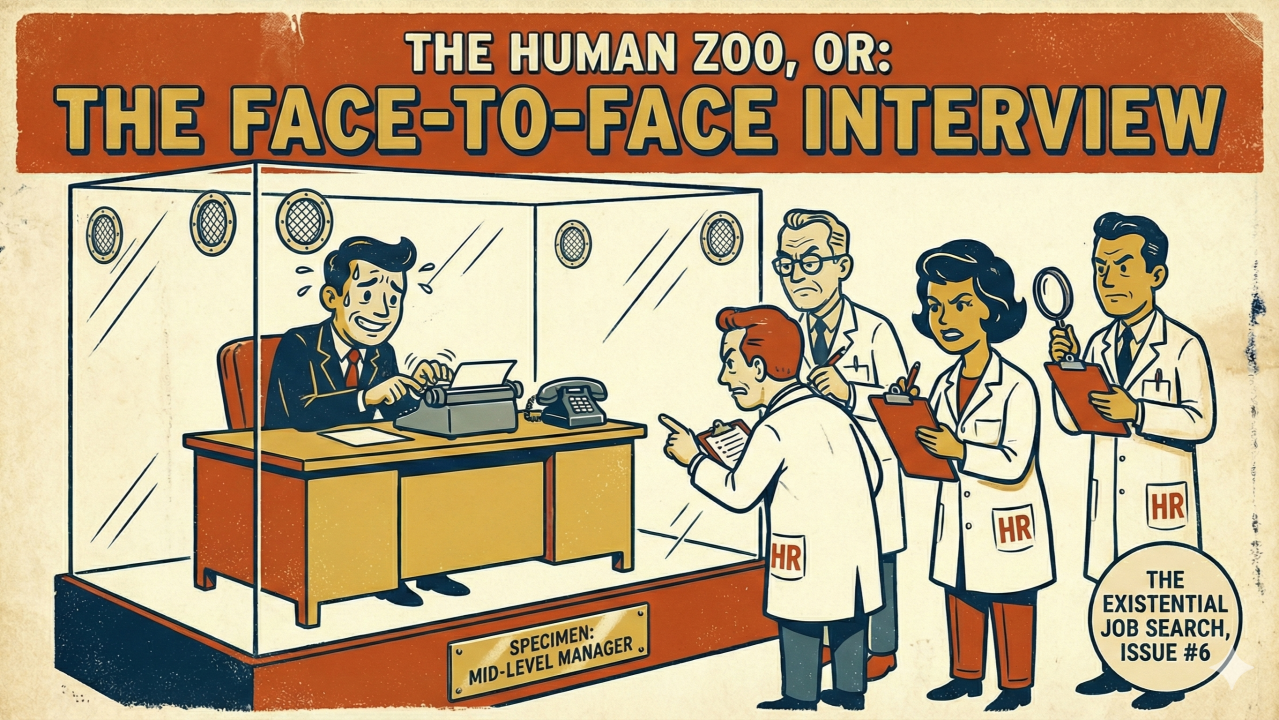
Welcome to the Human Zoo, or otherwise called: The Face-to-Face Interview.
I. The HR Gauntlet: The People Who Hate People
Before you even get to the person who might actually understand what you do for a living, you must pass the HR screen. This is where the absurdity reaches its peak. HR is the department tasked with ensuring "human capital efficiency," yet they are notoriously the most inefficient cog in the corporate machine. It is a department built on a paradox: they exist to optimize the "human element" while simultaneously doing everything in their power to strip it away. They are the "people people" who, upon closer inspection, often seem to harbor a deep-seated, clinical disdain for actual human beings.
The Efficiency Paradox: The Optimization of Friction
Consider the sheer, breathtaking irony of the HR efficiency mandate. This is the department that will lecture you on "agile workflows" and "streamlined communication" while forcing you to navigate a 14-step onboarding process that requires three different passwords and a physical signature on a document that was already digitized in 2012.
They are the architects of the very friction they claim to eliminate. They will spend six months "optimizing" a hiring pipeline only to let a qualified candidate sit in silence for three weeks because the person responsible for clicking "approve" is currently at a three-day offsite retreat focused on – you guessed it – operational efficiency. They don't solve problems; they categorize them into folders that no one will ever open, ensuring that every human interaction is filtered through a layer of administrative sludge that would make a Soviet bureaucrat weep with envy.
When HR talks about "efficiency," they aren't talking about getting you into the job faster or making your work life easier. They are talking about the efficiency of their own defensive perimeter. They have optimized the art of the "non-update" update, the automated rejection that arrives at 3:00 AM on a Sunday, and the interview scheduling process that requires the coordination of four different calendars, none of which actually reflect the reality of the participants' lives.
They are the department of "No," wrapped in the language of "Let me circle back on that." Their inefficiency is not a bug; it is a feature designed to ensure that only the most pathologically patient specimens make it through to the next enclosure in the zoo.
The "People Person" Myth: The Biohazard of Interaction
Then there is the myth of the "people person." We are told that HR is the heart of the company, the empathetic bridge between the cold machinery of Finance and the messy reality of the workforce. Yet, sitting across from an HR representative often feels less like a conversation and more like being observed through a thick sheet of plexiglass.
They treat human emotion like a biohazard that needs to be contained, neutralized, and filed away under "Personnel Issues." They preach "workplace wellness" and "psychological safety" while enforcing policies that treat employees like replaceable units of production. They are the ones who will send a company-wide email about the importance of "mental health days" on the same afternoon they deny a bereavement request because it didn't include a notarized death certificate.
There is a specific, chilling brand of "HR Nice" that is more terrifying than outright hostility. It is a smile that doesn't reach the eyes, a tone of voice that is perpetually stuck in "customer service mode," and a vocabulary consisting entirely of words designed to say nothing at all. They don't want to know who you are; they want to know if you are a liability. They aren't listening to your story; they are scanning for keywords that might trigger a future lawsuit.
To the "people people" of HR, you are not a person; you are a collection of potential risks, a series of compliance checkboxes, and a "human resource" to be extracted until the cost of maintenance exceeds the value of the output. They are the only people in the world who can look at a vibrant, talented human being and see nothing but a spreadsheet entry with a high probability of "attrition."
The Fallout Factor: Why They Don't Care If You Can Do the Job
Here is the most cynical part: HR never has to work with you. Once they've checked your boxes and handed you your badge, you become someone else's problem. They don't care if you're a genius or a fraud, as long as you meet the job requirements and get things done; they only care that you don't create "fallout." To HR, a "good hire" isn't someone who doubles the company's revenue; it's someone who never appears in a disciplinary hearing or a legal deposition. They would rather hire a mediocre compliant than a brilliant rebel, because the rebel requires "management," and management requires "work." They aren't looking for your superpower; they are looking for your lack of a paper trail.
II. The Gatekeeper vs. The Hiring Manager: A Tug-of-War with Your Career
It is vital to understand the fundamental conflict between the two people sitting across from you. They are not on the same team. They are engaged in a silent, desperate tug-of-war, and you are the rope.
The HR Gatekeeper: Their goal is to say "No." Every candidate is a potential lawsuit, a future headache, or a breach of a policy they spent three months writing. If they reject you, they have done their job perfectly—they have mitigated 100% of the risk you represent.
The Hiring Manager: Their goal is to say "Yes." They are drowning. Their team is overworked, their deadlines are looming, and they are tired of doing two people's jobs. They don't care about your "alignment with core values"; they care if you can fix the broken spreadsheet that’s been haunting their dreams since October.
The Strategy: You must appease the Gatekeeper’s need for safety while simultaneously signaling to the Hiring Manager that you are the life raft they’ve been waiting for. You have to be "Safe" for HR and "Essential" for the manager. It’s a delicate dance of being a boring rule-follower and a brilliant problem-solver at the exact same time.
III. The Manual Method for HR: Speaking the Language of the Damned
Since the HR screen is an audit, not an interview, you must treat it as such. You are not there to be liked; you are there to be "cleared." This requires a specific, ritualistic form of communication.
-
The Linguistic Mirror: HR representatives are trained to listen for specific cultural markers that signal you are a "safe" addition to the ecosystem. You don't need to babble buzzwords, but you do need to translate your achievements into their dialect. If they talk about "stakeholder management," don't just say you "talked to people." Use their terminology to prove you understand the organizational hierarchy. It’s not about being a drone; it’s about proving you can navigate the maze without tripping over the furniture.
-
The Governance Signal: When describing a challenge, don't just jump to the heroic ending. HR needs to know that you respect the "house rules." Briefly mention how you operated within the existing framework or consulted the necessary channels before you saved the day. This signals that you aren't a loose cannon who will ignore policy the moment things get stressful. It tells them that you are a professional who understands that in a large organization, how you solve a problem is often as important to HR as the solution itself.
-
The Emotional Neutralizer: If they ask about a difficult coworker, do not describe the person as "lazy" or "incompetent." Describe them as a "stakeholder with differing priorities." This signals that you can handle the inevitable toxicity of the office without running to HR every five minutes. You are proving that you can manage your own fallout.
-
The Compliance Smile: Maintain a level of "HR Nice" that matches theirs. It should be polite, professional, and entirely hollow. If you show too much real personality, you become a "cultural risk." If you show too little, you're a "flight risk." Aim for the dead center of the bell curve.
IV. The Standability Factor: Why They Fear the Brilliant Jerk
Once you’ve cleared the HR hurdle, you face the hiring manager. This is where the "Vibe Check" truly begins. In a stack of 10 candidates who all have similar qualifications, the final decision comes down to one thing: Do I want to be stuck in an airport with this person?
This is the "Standability" Factor. It is irrational, unquantifiable, and entirely human. It is driven by the manager's greatest fear: the Brilliant Jerk.
The Fear of the Toxic Genius
Hiring managers are terrified of the candidate who is technically brilliant but socially toxic. The Brilliant Jerk. The Toxic Genius. They know that one toxic personality can sink a team faster than a leaky submarine. They’ve all worked with one—the person who hits every KPI but makes everyone else want to quit.
They will almost always choose the Competent Companion over the Brilliant Jerk. Your goal is not to prove you are the smartest person in the room; it is to prove you are the safest option who can still get the job done. They aren't looking for a savior; they're looking for someone who won't make their life harder.
V. The Goldilocks Zone: The Fairy Tale of the "Perfect" Candidate
In the original fairy tale, Goldilocks was a shameless home-invader who was oddly picky about porridge temperature. In the corporate version, the hiring manager is the one looking for something that is "just right," while you are the one trying to avoid being eaten by the bears in HR. The Goldilocks Zone is that mythical, narrow strip of psychological real estate where you are competent enough to do the job, but not so competent that you make your boss feel insecure. It is the art of being "just right" in a world that is perpetually too much.
Navigating this zone is a survival skill. If you lean too far toward enthusiasm, you look like a golden retriever in a suit—lovable, but ultimately exhausting. If you lean too far toward expertise, you look like a threat to the existing hierarchy. You are looking for the sweet spot of Professional Detachment: the vibe of someone who is excellent at their job but doesn't need it to define their entire existence.
1. The Too Needy Specimen (The Golden Retriever)
- Behavior: Overly eager, laughs too hard at bad jokes, agrees with everything, and asks about benefits in the first five minutes.
- Perception: Desperate and lacking confidence. The interviewer sees a future of constant hand-holding and emotional labor.
- Manual Correction: Project Professional Detachment. Be prepared and engaged, but act like you have other options and a life outside this office.
2. The Too Arrogant Specimen (The Toxic Genius)
- Behavior: Corrects the interviewer, dismisses previous company experience, and acts like the job is beneath them.
- Perception: Toxic and high-maintenance. The interviewer sees a nightmare to manage who will likely leave in six months.
- Manual Correction: Project Respectful Skepticism. Ask tough, insightful questions, but frame them as a collaborative desire to help solve their problems.
3. The Just Right Specimen (The Competent Companion)
- Behavior: Engaged, asks insightful questions, shares credit with former teams, and admits minor mistakes with a clear lesson learned.
- Perception: Safe and self-aware. The interviewer sees a potential peer who understands the absurdity of the job and can get it done.
- Manual Correction: Your Goal. This is the sweet spot of being competent enough to do the job, but human enough to be stood in an airport.
The Great Un-Roboting: Recovering Your Humanity
You spent weeks practicing the STAR method for the AI. You’ve been conditioned to speak in a rigid, four-part harmony that satisfies an algorithm. Now, that conditioning is a liability. To a human interviewer, the STAR method sounds like a hostage reading a ransom note. It is structurally sound, but emotionally vacant. You need to stop reciting a script and start telling a story.
The Manual Override: Instead of STAR, think "Challenge, Action, Learning (CAL)."
- Challenge: Briefly set the scene. Keep it short. The interviewer cares about the conflict, not the background.
- Action: Focus on the messy part—the problem-solving, the collaboration, the moment you realized you were wrong. This is where the human connection happens. *
- Learning: What is the self-aware, slightly weary takeaway? This proves you're not a robot; you're a person who has suffered and gained wisdom.
VI. The Reverse Interview: Turning the Tables
The entire interview process is designed to make you feel small, grateful, and desperate. The only way to regain your dignity is to turn the tables. The questions you ask at the end are not a formality; they are your final chance to prove you are a person with agency.
The Questions That Kill the Vibe Check (In a Good Way)
Do not ask about vacation time. Ask questions that prove you understand the job is a leaky submarine and you want to know where the biggest holes are.
-
The Problem Question: "If I were to start tomorrow, what is the single biggest problem the team is currently ignoring because they are too busy fighting fires?" (This shows you are a problem-solver, not a task-doer).
-
The Failure Question: "Tell me about a project that failed spectacularly in the last year. What was the post-mortem like, and what did the company actually learn from it?" (If they say "nothing ever fails," run).
-
The Culture Question (The Real One): "When the team is under the most pressure, what is the first cultural value that gets thrown out the window?" (This cuts through the mission statement and gets to the unvarnished reality).
-
The Manager Question: "What is the biggest misconception your team has about your management style?" (This is a power move. It forces self-reflection and shows you are already thinking about the working relationship).
The Unfiltered Reality: The interviewer is often more nervous than you are. They are terrified of hiring a dud. Your confident, slightly weary questions make them feel like they are talking to a peer, not a supplicant.
VII. Conclusion: The Final Word on the Human Zoo
You have survived the robots. You have passed the vibe check. You have proven you are a competent, self-aware, and slightly weary human being who can tolerate the absurdity of corporate life.
The human interview is not about finding the best candidate; it is about finding the candidate who is the least likely to cause drama. By dropping the robotic script and engaging in a genuine, problem-focused conversation, you prove you are the latter.
That's all for today.
Go forth and be slightly less miserable in your job hunt.
Rob
P.S. Next Week: Post-Interview Purgatory
You've left the room. Now the real suffering begins.
Next week, we're talking about "Post-Interview Purgatory: The Art of the Follow-Up and the Inevitability of Ghosting." We'll cover the thank-you note that doesn't sound desperate, how to manage the agonizing wait, and the cynical acceptance of being ghosted.
Don't miss it.
(This issue of The Existential Job Search was brought to you by UniqU. We automate the boring, robotic parts of the job search (like finding matching jobs, positioning you as a superstar, customizing your resumes and writing job applications) so you can focus on being human. Our platform helps you research the real problems a company is facing, so you can ask the right questions and pass the Vibe Check with professional detachment. Try UniqU for free here and get your dream job. Faster.)