
The Existential Job Search: Issue #7
Welcome back to the Existential Job Search Club. If you’re new here, welcome to the support group you never wanted to join.
You’ve just finished the interview. You performed the ritualistic dance, answered the "where do you see yourself in five years" question without laughing, and managed to look like a functioning human being for forty-five minutes. You closed the Zoom window or walked out of the office feeling a flicker of something dangerously close to hope. You think, "Maybe this is the one."
And then, the silence hits.
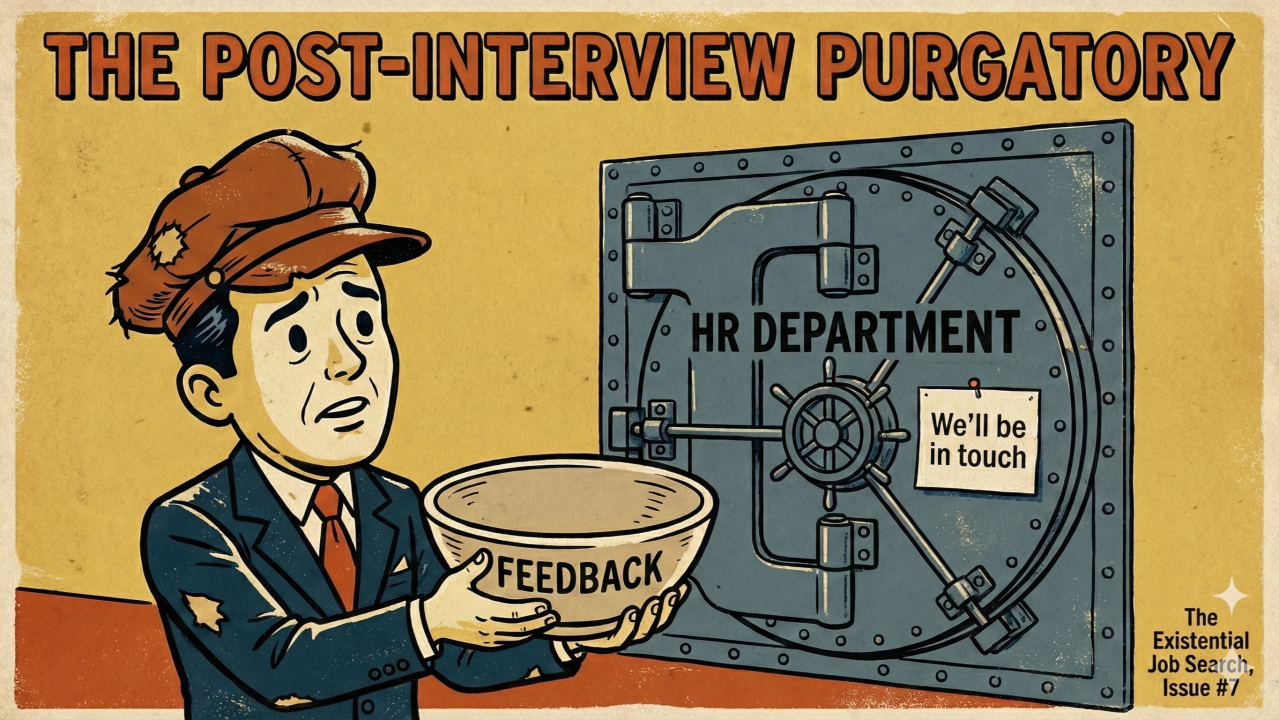
Welcome to Post-Interview Purgatory. This is the administrative limbo where time dilates, every minute feels like an hour, and your inbox becomes a graveyard of unfulfilled expectations. It’s the agonizing period where you are left to wonder if you’re a top candidate or just a backup plan for a hiring manager who is currently "internalizing feedback."
I. The Thank-You Note Ritual: The Beggar's Bow
Ah, the thank-you note. That quaint, archaic ritual, a relic from a time when politeness was still a currency. In the modern job search, it’s less about gratitude and more about a final, desperate attempt to nudge the scales in your favor.
Writing a thank-you note is a delicate balancing act. You want to be professional, but you often end up sounding like a Victorian orphan in a Dickens novel, tugging at the hiring manager’s sleeve and whispering, "Please, sir, I want some more… feedback." You’re essentially Oliver Twist, holding out your empty bowl and hoping for a tiny ladle of corporate gruel to sustain you through the coming weeks of silence. It’s the beggar’s bow after the performance, a subtle plea for remembrance in a sea of forgotten faces.
Most advice tells you to be sincere, specific, and reiterate your interest. This is all true, but it misses the cynical core. Your thank-you note isn’t for them; it’s for you. It’s a way to feel like you’ve done everything possible before the inevitable silence descends. It’s a psychological balm, not a game-changer.
The Manual for the Modern Thank-You:
- Be Prompt, Not Desperate: Send it within 24 hours. Any later, and you look disorganized. Any sooner, and you look like you were hovering over your inbox, which, let’s be honest, you were. But don’t look like it.
- Personalize, Don't Stalk: Reference a specific point of conversation. "I particularly enjoyed our discussion about the existential dread of quarterly reports…" This shows you were listening, not just performing. But avoid anything too personal; you’re not inviting them to brunch.
- Reiterate Value, Not Need: Instead of saying, "I really need this job," subtly remind them of how you can solve their problems. "I’m confident my experience in navigating corporate bureaucracy will be invaluable in streamlining your team’s current administrative sludge."
- Keep it Brief, Not a Manifesto: They have other candidates to ignore. Your note should be a polite, professional whisper, not a desperate shout.
Remember, the thank-you note is your last official act of control. After this, you surrender to the whims of the corporate machine.
II. The Art of the Non-Desperate Check-In: The Whisper in the Void
The thank-you note is sent. The silence begins. And it stretches. And stretches. The recruiter said, "We’ll be in touch within a week." That was two weeks ago. Your brain, a cruel master, begins to replay every awkward pause, every slightly off-color joke you made. You start to craft the perfect follow-up email in your head, only to delete it, convinced it sounds too needy.
This is the Non-Desperate Check-In, an art form akin to whispering into a black hole and hoping for an echo. The goal is to appear engaged, not unhinged. You want to remind them you exist without implying you’ve set up a tent outside their office.
The Manual for the Measured Nudge:
- The Timing is Everything (and Arbitrary): Wait at least a week beyond their stated timeline. If they said a week, wait two. If they gave no timeline, wait 7-10 business days. This shows you respect their (non-existent) process.
- The Value-Add, Not the Whine: Your check-in isn’t a complaint; it’s an opportunity to provide new, relevant information. "Since our conversation, I’ve been thinking about X problem, and I came across Y article/solution that I believe could be highly relevant to your team’s current challenges." This positions you as a problem-solver, not a pest.
- The Polite Inquiry, Not the Demand: Frame your email as a gentle inquiry about the process, not a demand for an update on your status. "I hope this email finds you well. I’m just checking in on the timeline for the [Position Name] role, as I remain very interested in the opportunity." This is corporate speak for, "Are you ever going to get back to me, or should I assume I’ve been ghosted?"
- The Single Attempt: One check-in is professional. Two is pushing it. Three is a one-way ticket to the spam folder. Know when to fold ‘em.
III. The Ghosting Acceptance: The New Corporate Standard
Let’s be brutally honest: Ghosting is the new corporate standard. It’s not just for bad dates anymore; it’s for bad hiring practices. You will be ghosted. Not because you’re not good enough, but because HR departments are too busy sending out "workplace wellness" memos to send a personalized rejection email. It’s the ultimate act of administrative cowardice, a silent declaration that your time and effort are utterly meaningless.
The Cynical Truth of Silence:
- It’s Not You, It’s Them: Their silence isn’t a reflection of your value; it’s a reflection of their inefficient "people processes." They are either overwhelmed, disorganized, or waiting for their first choice to accept (more on that later).
- The Cost of Courtesy: Sending a personalized rejection takes time and effort. In a world optimized for "human capital efficiency," courtesy is an unnecessary expenditure. An automated email is cheap. No email is free.
- The "Backup Plan" Strategy: Sometimes, they keep you in limbo as a backup. If their first choice falls through, they can always circle back to you. Your ghosting is their strategic flexibility.
Acceptance is key. Expect to be ghosted. When it happens, take a deep breath, curse the corporate machine, and move on. Your dignity is worth more than waiting for a reply that will never come.
IV. Managing the Wait: The Zen of Corporate Limbo
The wait is a psychological battlefield. Your mind will conjure worst-case scenarios, replaying every perceived misstep. This is where you must cultivate the Zen of Corporate Limbo – a state of detached awareness that allows you to continue your job search without being consumed by the agonizing silence.
The Manual for Mental Survival:
- Keep Applying: The best way to manage the wait is to pretend the interview never happened. Continue applying for other jobs. The next opportunity is your best distraction.
- Set a Mental Deadline: Give them a reasonable amount of time (e.g., two weeks after your last check-in). If you haven’t heard back by then, mentally close the door on that opportunity. It’s not a final rejection; it’s a strategic disengagement.
- Distract Yourself with Meaningless Tasks: Clean your apartment. Organize your sock drawer. Learn to play the ukulele. Anything to keep your mind from obsessing over an email that isn’t coming.
- Vent to a Trusted Confidant: Share your frustrations with someone who understands the absurdity of the job search. Misery loves company, especially when that company is equally cynical.
V. The Anatomy of the "Non-Update" Update: A Translation Guide
Just when you’ve accepted your fate, an email arrives! Your heart leaps. This is it! You open it, and it reads: "Thank you for your continued patience. We are still internalizing feedback and will circle back with an update soon."
This is the Non-Update Update, a masterpiece of corporate obfuscation. It says everything and nothing at the same time. It’s designed to keep you on the hook without committing to anything. Here’s a cynical translation guide:
- "We’re still internalizing feedback": Translation: Our hiring manager is on vacation, or they can’t make up their mind, or they’re waiting for their first choice to accept, and you’re the backup plan.
- "The hiring manager is traveling": Translation: The hiring manager is avoiding making a decision, or they’re actually traveling, but they’ve decided your application isn’t important enough to warrant a quick email from their phone.
- "We’re exploring other candidates": Translation: "We found someone we like more, but we’re not 100% sure they’ll say yes, so we’re keeping you warm just in case."
- "We’ll be in touch shortly": Translation: We have no idea when we’ll be in touch, or if we’ll be in touch at all. This is our polite way of saying, "Don’t call us, we’ll call you (maybe)."
VI. The "Second Choice" Syndrome: Maintaining Your Dignity in Limbo
Sometimes, the silence breaks, but not with an offer. It’s a request for another interview, or a vague inquiry about your continued interest. This is the "Second Choice" Syndrome – you’re not the first pick, but you’re good enough to keep on the bench. They’re exploring other candidates, but they’re not quite ready to let you go.
The Manual for the Backup Plan:
- Recognize the Signs: Vague communication, sudden renewed interest after a long silence, or a request for a "quick chat" that feels like a re-interview. These are all red flags that you’re not their top priority.
- Maintain Your Leverage: Don’t drop everything for them. Continue your job search. If they sense desperation, they’ll exploit it. If they sense you have other options, they might move faster.
- Ask Direct Questions (Politely): "I appreciate you circling back. Could you provide some clarity on the current stage of the hiring process and what the expected timeline looks like from here?" This forces them to be more transparent.
- Know Your Worth: Being a second choice isn’t a failure; it’s a strategic position. But don’t let them string you along indefinitely. Your time is valuable, even if they don’t seem to think so.
VII. Conclusion: Escaping Purgatory
Post-Interview Purgatory is a test of patience, resilience, and your ability to maintain a healthy level of cynicism. It’s designed to wear you down, to make you question your worth, and to remind you that in the corporate world, you are always, ultimately, expendable.
But by understanding the mechanics of the "non-update" update, by accepting the inevitability of ghosting, and by maintaining your dignity through the silence, you can navigate this agonizing phase without losing your soul. You can emerge from Purgatory, not unscathed, but certainly wiser.
Go forth and be slightly less miserable in your job hunt.
Rob
Next Week: The Marathon: Surviving the Gauntlet of Follow-Up Interviews
You’ve escaped Purgatory. But the Human Zoo has more enclosures. Next week, we’re talking about the Interview Marathon – how to maintain your sanity and your story through multiple rounds of increasingly specific interviews. From the peer panel to the "Final Boss," we’ll show you how to keep your performance consistent without becoming a robot.
Don't miss it.
(This issue of The Existential Job Search was brought to you by UniqU. While you’re stuck in Purgatory waiting for a "non-update" update, UniqU is working to ensure you’re never just a backup plan. Our Deep Research tools give you the insider intelligence to turn a "quick chat" into a power move, while our AI Interview Coaches provide real-time voice feedback to keep your performance sharp for the next round. Don’t just wait for a response—build a pipeline so strong that ghosting becomes their loss, not yours. Escape Purgatory and try UniqU for free here.)