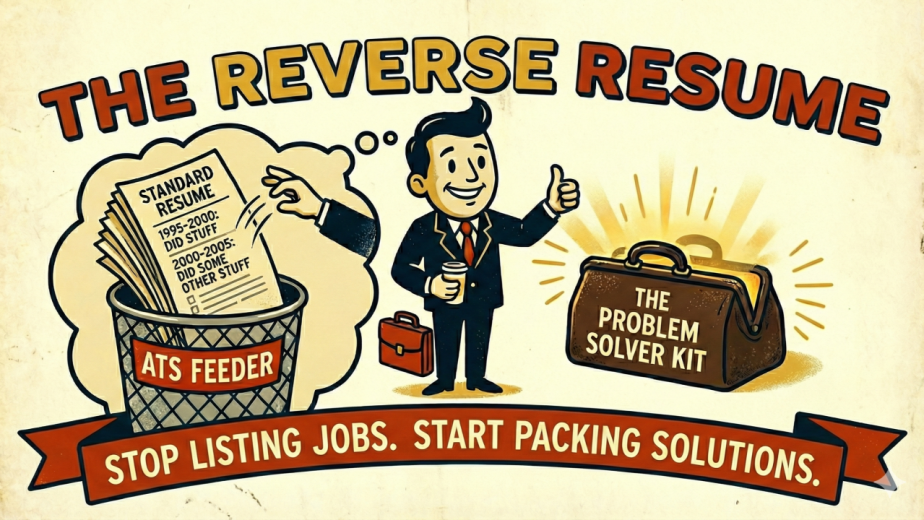

<p><strong><em>tl;dr: Getting hired ends the immediate search, not career uncertainty. Build a light Career Maintenance System that captures evidence, reviews what changed, keeps relationships alive, and preserves your options before the next transition turns preparation into an emergency.</em></strong></p><h2>The Existential Job Search: Issue #15</h2><p>You got the job.</p><p>The offer is signed. The farewell messages are sent. The emergency résumé has been folded up, placed in a drawer, and covered with enough relief to make you believe you will never need it again.</p><p>Your reward is a new laptop, fourteen systems with separate passwords, and the sudden expectation that you understand an organization nobody has successfully explained to anyone.</p><p>Still, you made it. The job search is over.</p><p>For now.</p><p>When we last dealt with your former employer in <a href="https://www.linkedin.com/pulse/dead-employee-walking-surviving-purgatory-notice-maciejewski-t51ye/" target="blank" rel="noopener noreferrer">Dead Employee Walking</a>, the goal was to leave professionally without letting the notice period eat what remained of your soul. Now the badge works, your calendar is filling up, and a quieter temptation has arrived: forgetting everything the search just taught you.</p><p>Understandable. Also expensive.</p><p><strong>The new job is not a prophecy of disaster. It is simply not a lifetime warranty.</strong> This role might last for months or for many good years. The evidence cannot tell you which. Neither can the person who described the company as a "family" during your final interview.</p><p>We are not going to predict the next crisis. We are going to make sure Future You does not have to rebuild an entire career from browser history and panic.</p><h2>The comforting lie of permanent arrival</h2><p>Employment creates a peculiar kind of amnesia.</p><p>During the search, you remembered every accomplishment, maintained every contact, watched your industry, and could explain your value before the coffee cooled. Three months into a new role, your résumé becomes an archaeological site. Six months later, your professional network mainly consists of people asking whether you have completed the mandatory security training.</p><p>The numbers do not give us a neat countdown to your next exit.</p><p>In January 2026, the <a href="https://www.bls.gov/news.release/tenure.nr0.htm" target="blank" rel="noopener noreferrer">U.S. Bureau of Labor Statistics reported</a> median tenure with a current employer of 4.1 years. For management occupations, the median was 6.1 years. At the same time, 20.6 percent of wage and salary workers had been with their employer for one year or less.</p><p>That is a mixed labor market, not an alarm clock. Median tenure is time already served by employed workers at a point in time. It does not mean a new hire has a 4.1-year expiration date stamped under the collar.</p><p>A separate <a href="https://www.bls.gov/news.release/nlsoy.nr0.htm" target="blank" rel="noopener noreferrer">BLS longitudinal study</a> followed Americans born from 1957 to 1964. They averaged 12.9 employer-defined jobs between ages 18 and 58, with more than 40 percent of those jobs held before age 25. Later transitions still happened. Of the jobs begun at ages 45 to 54, 21 percent ended within one year and 56 percent within five years.</p><p>That cohort is not a horoscope for your career. It does show that changing employers is not a youthful phase everyone eventually grows out of, like loud music or trusting the printer.</p><p>Tenure is not immunity either. BLS counted <a href="https://www.bls.gov/news.release/disp.htm" target="blank" rel="noopener noreferrer">3.3 million U.S. workers displaced in 2023 to 2025</a> from jobs they had held for at least three years. Its narrow definition covers plant or company closures and moves, insufficient work, or abolished positions and shifts. That figure is a count, not your personal probability.</p><p>The point is modest: <strong>career transition risk is real, uneven, and impossible to schedule. Preparation beats prediction.</strong></p><h2>Your Career Maintenance System</h2><p>Job-search preparation usually happens the way people buy umbrellas: five minutes after the weather has become personally insulting.</p><p>So we need a system small enough to run while employed. Not a second job. Not a nightly ritual of refreshing layoff forums. Four habits: <strong>capture, review, connect, and prepare.</strong></p><p>### 1. Capture before your memory starts editing</p><p>Your annual review should not be the first time you try to remember what you did eleven months ago.</p><p>Keep a private achievement and feedback log. Record only material you are entitled to keep. Never copy confidential, proprietary, customer, or employer-owned information into personal files.</p><p>For each useful entry, note:</p><ul><li>the date or period;</li><li>the problem or responsibility;</li><li>what you did;</li><li>the result you can support without exposing protected information;</li><li>feedback you received; and</li><li>what the work taught you.</li></ul><p>This is not a trophy cabinet. It is a memory aid.</p><p>If the result cannot be expressed with a safe number, name the concrete change: a decision made, a delay removed, a risk surfaced, a process clarified, or a team unblocked. Do not invent precision because LinkedIn seems to enjoy percentages.</p><p>Update your Reverse Resume every quarter. Add the problems you are solving now, not just your latest title and a list of duties copied from the job description. Quarterly is not magic. It is simply frequent enough to catch the details before they disappear into the same void that contains your first-week passwords.</p><p>### 2. Review what changed</p><p>Before the search fades from memory, run a short after-action review.</p><p>Ask:</p><ul><li>Which stories made people pay attention?</li><li>Which applications produced conversations?</li><li>Where did the process stall?</li><li>Which contacts helped, and how can you thank them without immediately asking for something else?</li><li>Which parts of your search material were painful to reconstruct?</li><li>What would you refuse to do the same way next time?</li></ul><p>Save the answers. You paid for them in time, rejection, awkward interviews, and a medically inadvisable relationship with your inbox.</p><p>Then schedule a recurring "what changed?" check. Look at your responsibilities, achievements, skill gaps, professional relationships, and appetite for staying.</p><p>Skills belong in that check. In the <a href="https://www.weforum.org/publications/the-future-of-jobs-report-2025/" target="blank" rel="noopener noreferrer">World Economic Forum’s Future of Jobs Report 2025</a>, surveyed large employers expected 39 percent of workers’ core skills to change by 2030. That is an employer forecast, not a measured outcome or a prediction about you. Industries and economies differ.</p><p>Use it as a prompt for better questions:</p><ul><li>What can I do now that I could not do six months ago?</li><li>What is becoming more important in my field?</li><li>Which task is disappearing, changing, or moving to another team?</li><li>What skill would make my current work easier instead of merely decorating my profile?</li></ul><p>You do not need to chase every new tool announced by a founder standing in front of a gradient background. You need enough awareness to notice when your professional story and the work around you are drifting apart.</p><p>### 3. Connect without becoming a networking appliance</p><p>Most people dislike "networking" because it often means pretending to care about a stranger’s thought-leadership carousel while quietly needing a favor.</p><p>Do something more human.</p><p>Keep close relationships close. Maintain a wider circle too: former colleagues, clients, peers, suppliers, and people you met during the search. Send the useful article. Congratulate the promotion. Ask how the difficult project ended. Offer help when you can do it honestly.</p><p>There is evidence for keeping that circle broad. A <a href="https://doi.org/10.1126/science.abl4476" target="blank" rel="noopener noreferrer">2022 randomized study published in Science</a>, based on changes to LinkedIn’s "People You May Know" recommendations across more than 20 million users, found that weaker ties increased job transmission. The effect was nonlinear, varied by industry, and changed depending on how tie strength was measured.</p><p>The lesson is not "weak ties always win." It is that useful information can travel through people beyond your closest circle.</p><p>There is no scientifically blessed outreach schedule. Choose a pace you can sustain without turning every relationship into a quarterly sales sequence. One genuine message beats twelve automated "Hope you’re well" ambushes.</p><p>### 4. Prepare while nothing is on fire</p><p>Career preparation in a crisis is slow because every document contains a blank space where your memory should be.</p><p>Keep the basics usable:</p><ul><li>a current résumé or Reverse Resume;</li><li>a short record of roles, dates, and responsibilities;</li><li>a story bank for interviews and reviews;</li><li>a list of people who may be suitable references, without assuming their consent;</li><li>your current professional profile;</li><li>copies of qualifications and documents you lawfully own; and</li><li>a short note on what you want more of, less of, and never again.</li></ul><p>You do not need to broadcast that you are searching. You do not need to apply for jobs as a hobby. You are reducing the amount of reconstruction Future You will have to do under pressure.</p><p>The research reviewed here does not prove that a quarterly update, an achievement log, or occasional relationship maintenance will shorten your next search. These are operating practices, not guaranteed outcomes. Their value is simpler: they preserve evidence and options before stress starts deleting both.</p><h2>The minimum viable maintenance schedule</h2><p>The system should be boring. Boring systems survive busy weeks.</p><p>Try this as a starting point:</p><p><strong>Now:</strong> Write the post-search after-action review while the absurd details are still fresh.</p><p><strong>Once a month:</strong> Add meaningful outcomes and feedback to your private log. Send one or two genuine messages to people you value.</p><p><strong>Once a quarter:</strong> Update your Reverse Resume, scan for skill changes, review your professional materials, and ask what has changed in the role or around it.</p><p><strong>When the role changes:</strong> Record new scope, expectations, decision rights, and success criteria. If somebody quietly adds three departments to your responsibilities, do not wait for the performance review to discover that the paperwork still thinks you manage one spreadsheet and a fern.</p><p>These intervals are defaults, not sacred science. Adjust them to your work and energy. The system has failed if maintaining your career becomes another source of permanent dread.</p><h2>"Can I please just enjoy the new job?"</h2><p>Yes.</p><p>Please do.</p><p>A new role can be good. Your manager may be competent. Your colleagues may be decent humans. The work may fit, the pay may arrive, and the coffee machine may require only one engineering degree.</p><p>Preparation is not disloyalty, pessimism, or a refusal to be present. It is the professional equivalent of knowing where your passport is. You hope you will not need it urgently. You still do not store it in a box labeled "miscellaneous cables, 2014."</p><p>Keep the system light. Spend your attention on learning the role, clarifying expectations, understanding who makes decisions, and producing work you can stand behind.</p><p>That is where the next part of TEJS begins.</p><p>The job-search arc is closed. The workplace-survival arc is open, because apparently signing the contract was only the end of the interview you could see.</p><p>Next time: the probationary period, where expectations are vague, judgment is immediate, and everyone insists you are "settling in nicely" while taking notes.</p><p><strong>That’s all for this week.</strong></p><p><strong>Go forth and be slightly less miserable in your job hunt.</strong></p><p>Rob</p><p>P.S. Which part of your career will you keep current now that the immediate job-search emergency is over? TEJS is sponsored by <a href="https://www.getuniqu.com/" target="_blank" rel="noopener noreferrer">UniqU</a>, a platform designed to help candidates navigate the job search. Take a look before Future You has to reconstruct everything from browser history and panic.</p>
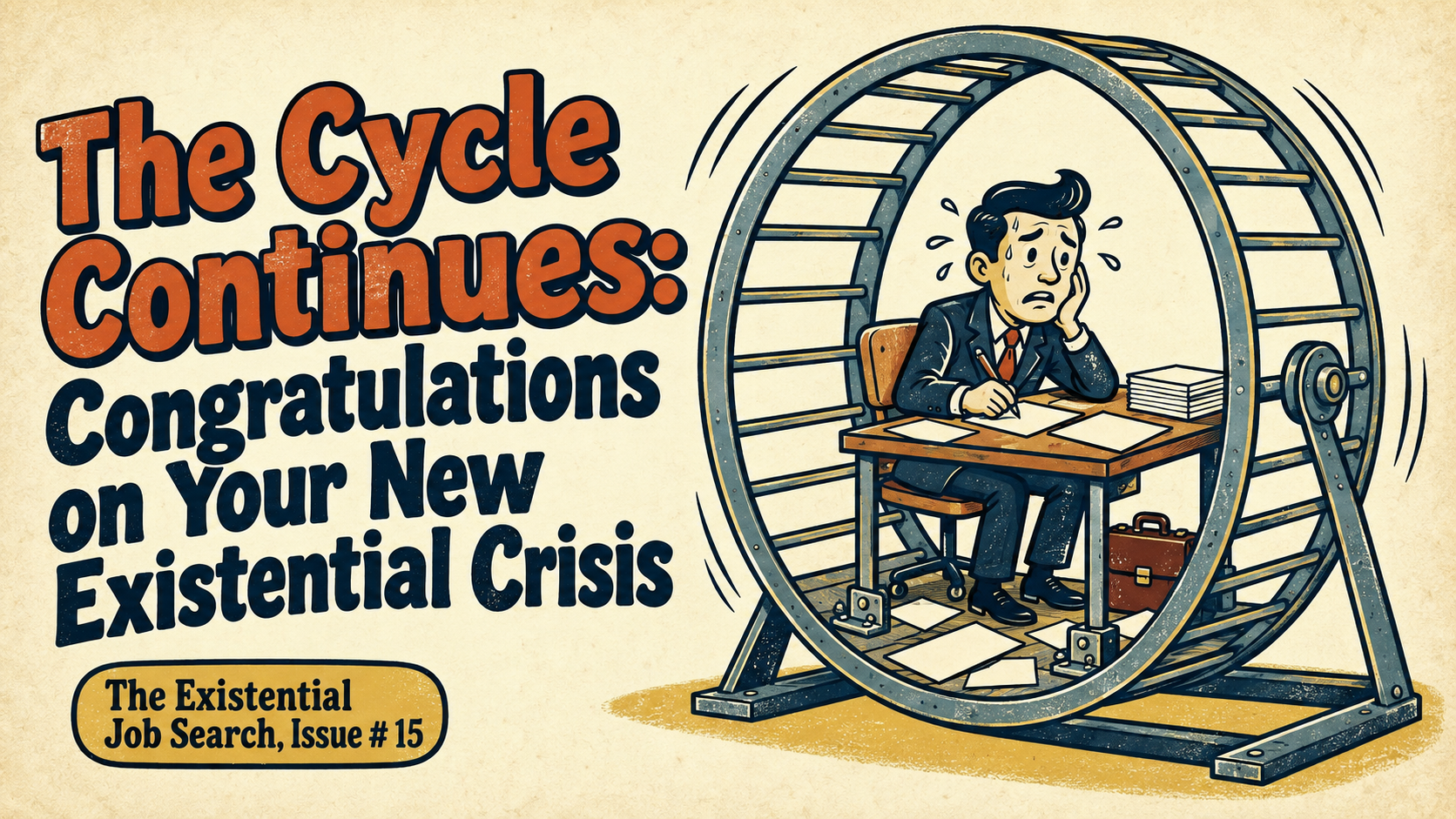
The Cycle Continues: Congratulations on Your New Existential Crisis