
tl;dr: Probation is a two-way suitability check, not a rights-free waiting room. Use it to turn vague expectations into checkpoints, compare the promised job with the lived one, record important agreements and check the rules that apply where you work before making a decision about staying or leaving.
Probation is usually presented as a test the employer gives you. That’s only half the arrangement. It’s also your first chance to compare the job you accepted with the job that actually turned up.
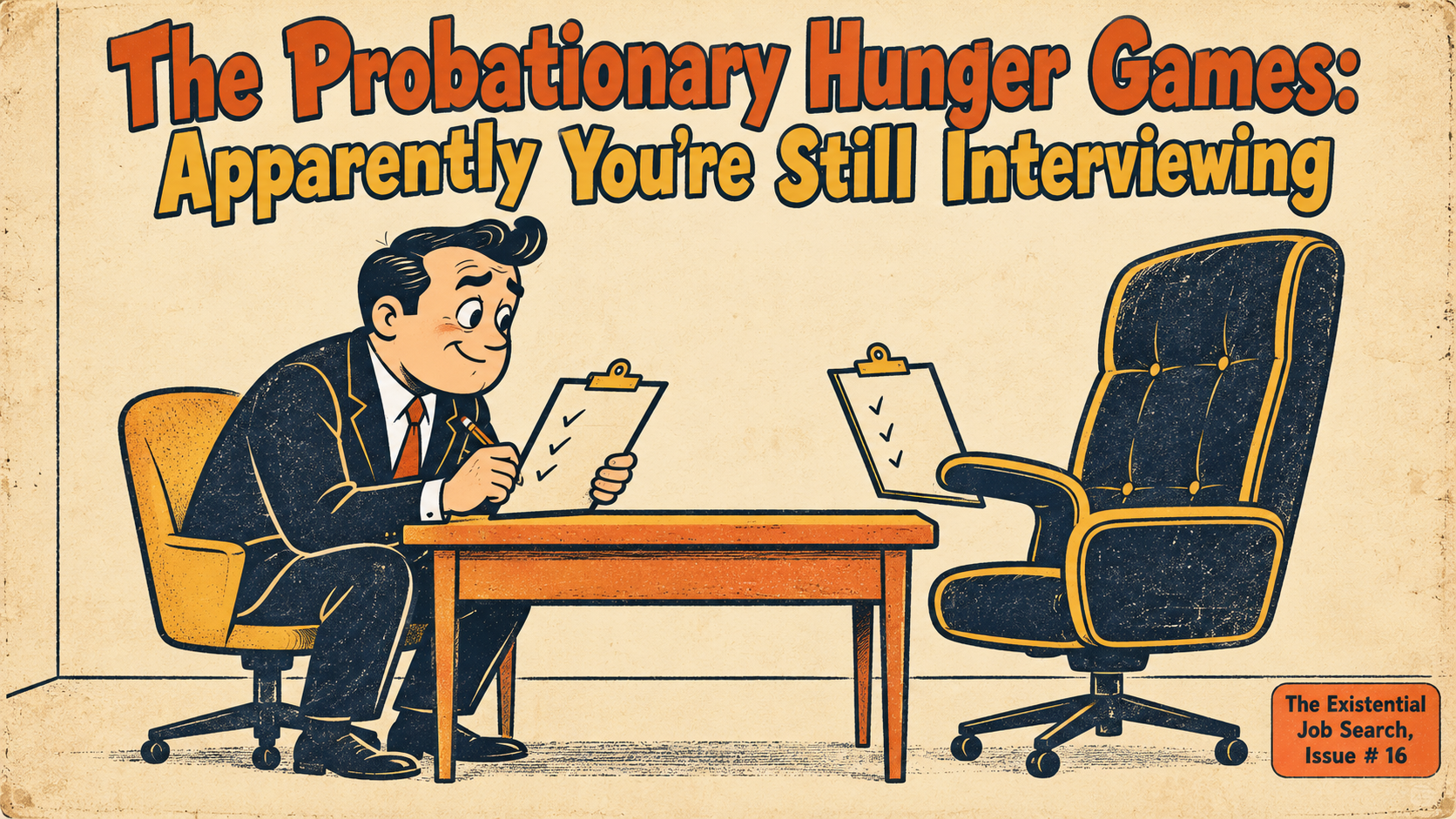
And there is the awkward truth of a probationary period: apparently, you’re still interviewing.
That’s a useful metaphor, not a legal status. It doesn’t mean every new hire needs an active escape plan or should spend work hours applying elsewhere. A job description, an offer letter and a polished interview process are promises made before the evidence arrives. Probation is when the evidence starts turning up.
The previous TEJS edition, Dead Employee Walking: Surviving the Purgatory of Notice, dealt with the period after resignation. This edition asks the earlier question: what can you learn before a new job becomes another notice period?
The employer is assessing you. You are assessing the job.
Official guidance treats probation as a two-way suitability check. Acas describes it as a period when an employer can assess performance, skills and organisational fit, while the employee checks whether the role and organisation are right for them. Australia’s Fair Work Ombudsman makes the same basic point: probation gives both sides a chance to check suitability.
That changes how you approach the first few weeks. Looking competent is part of it. So is collecting information.
Does the work match the scope you were promised? Is the manager available when a decision is needed? Do you have the tools, people and authority to do the job? Are priorities becoming clearer, or do they keep changing without explanation? When you ask for context or training, does any support arrive?
Those questions don’t prove the employer has failed. They give you evidence to work with before you form a confident view.
Turn the mystery into checkpoints
A bad probation experience can feel like being judged by a panel that refuses to show you the scorecard. The practical answer is to drag the scorecard into view.
Ask early:
- What does good performance look like by the next review?
- Which outcomes matter most in the first month or quarter?
- What evidence will be used to assess progress?
- Which decisions can I make myself, and which need approval?
- What training, access or support should I expect?
- When will we review this, and what would a successful outcome look like?
Acas recommends clear expectations, regular formal reviews, informal check-ins, feedback, support or training, written records and an outcome that isn’t a surprise. That’s UK good-practice guidance, not a universal legal checklist. It is still a useful standard for a conversation in almost any workplace.
After a meeting, write down what you agreed. A short note will do: the priority, the owner, the deadline, the support promised and the next review point. Send it to the relevant person if that’s normal in the organisation. You are not building a courtroom drama in your inbox. You are stopping two people from leaving the same meeting with different memories.
Watch the gap between the offer and the lived job
The most useful probation question isn’t, "Am I passing?" It’s, "What has the job shown me?"
A role can be harder than advertised and still be a good role. A new manager can be imperfect and still be someone you can work with. A priority can change for a perfectly legitimate business reason. Not every surprise is a betrayal.
Patterns are different.
One changed priority is normal. Every priority changing before you can finish anything is worth noticing. Difficult feedback can be useful. Vague criticism with no example, support or route to improvement gives you very little to work with. A frantic onboarding week happens. Being denied the access you need, then criticised for the result, calls for a direct conversation.
This is why the two-way nature of probation matters. The employer is deciding whether your work fits the role. You are deciding whether the role gives you a fair chance to do that work.
Probation is not a rights-free waiting room
The legal meaning of probation varies sharply by jurisdiction, contract, worker status, employer size and reason for termination. The label is not a universal rule.
Acas says probation is not legally required in the UK and can be any length. It also lists rights that apply from day one, including minimum wage, paid holiday and protections concerning discrimination and whistleblowing. In Australia, the Fair Work Ombudsman says probationary employees still receive the National Employment Standards entitlements that apply to them, including applicable leave and termination notice.
A contractual probation period can also differ from a statutory eligibility threshold. Australian guidance, for example, generally puts the minimum employment period for an unfair-dismissal claim at six months for a larger business and twelve months for a small business, subject to other eligibility rules. That doesn’t mean probation always lasts six or twelve months.
In much of the United States, at-will employment is the default, although contracts and legal exceptions can limit it. The EEOC states that probationary status does not permit discharge or discipline for a reason prohibited by Title VII. The practical conclusion is simple: if a decision about your employment is becoming serious, check the rules where you work and read the contract. General career advice cannot replace jurisdiction-specific advice.
Should you keep interviewing?
Sometimes an external search is sensible risk management. Sometimes it creates problems involving confidentiality, conflicts, work time, equipment or contractual duties. The evidence supports continuing to evaluate the job. It does not support telling every employee to keep interviewing until probation ends.
A better rule is to keep your judgment switched on.
If the job broadly matches what you were promised, expectations are becoming clearer and support is available, focus on the work and learn the organisation. If the role is materially different, the decision process is opaque, or repeated conversations produce no clarity, you may decide an external search belongs in your plan. That’s a personal and practical decision, not a universal probation rule.
You can also leave during probation, but the mechanics depend on your contract and jurisdiction. Acas says a UK employee must give the applicable statutory or contractual notice. Australian guidance likewise says applicable notice or pay in lieu can still be due when employment ends during probation. Don’t assume "probation" means "no notice."
The interview did not end. It changed direction.
The first interview asked whether you could do the job. Probation lets you test whether the job is real in the way it was presented.
Ask for clear measures. Seek feedback before the final review. Record important agreements. Compare the promise with the pattern. Give a reasonable explanation time to become true, and give repeated contradictions the attention they deserve.
You don’t have to panic at every awkward week. You also don’t have to ignore what the awkward weeks are telling you.
A probationary period isn’t a verdict handed down by a mysterious committee. It’s a short, consequential piece of evidence. Read it while you still have choices.
Rob
P.S. What will you look for before deciding whether this probationary role is still the right job for you?
If your organization is navigating AI, career disruption, or the human side of work change, UniqU helps teams turn messy transitions into clearer operating systems. Learn more at UniqU.
References
- Acas: Probation periods
- Acas: Probation reviews
- Fair Work Ombudsman: Probation
- Fair Work Ombudsman: Unfair dismissal
- Fair Work Ombudsman: Dismissal and notice
- National Conference of State Legislatures: At-will employment overview
- US Equal Employment Opportunity Commission: Discharge and discipline
- Previous TEJS edition: Dead Employee Walking: Surviving the Purgatory of Notice