
tl;dr: A performance review is not a pure measurement of a year’s work. Keep a short, ethical record of problem, action, evidence, business effect, context, and next alignment so the review begins with a concrete conversation instead of a memory contest. The record can improve clarity, but it cannot guarantee a fair rating, raise, promotion, or escape from organisational politics.
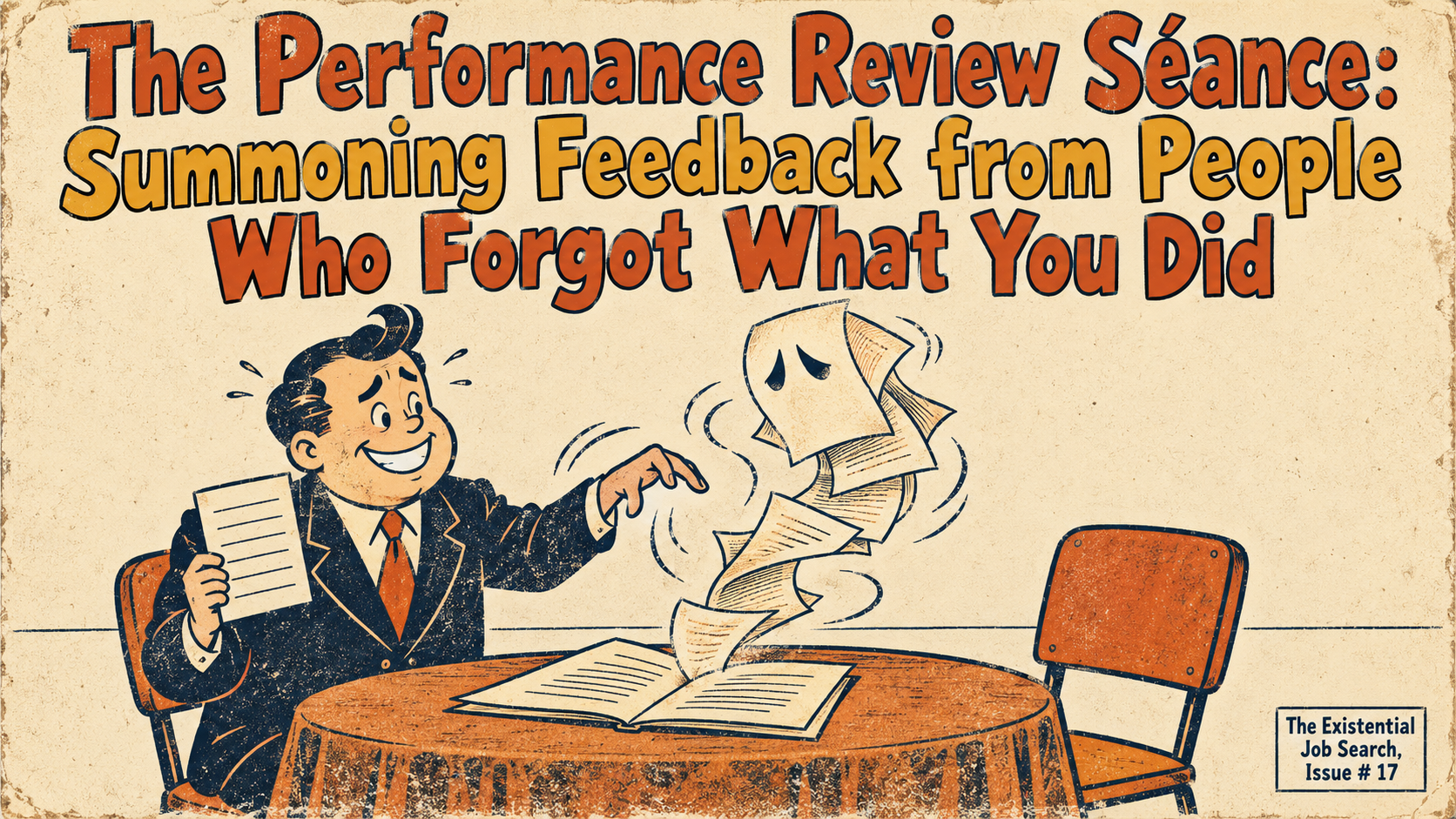
There is a particular kind of office séance that happens near the end of the year.
Everyone gathers around a performance-review form. The manager opens a blank field. The employee waits. Then both parties attempt to summon twelve months of work from memory.
Up come the usual spirits: the project that went well, the awkward meeting, the difficult customer, the recent mistake, and the thing everyone praised in March but nobody can quite locate now.
The performance review is supposed to be about the work.
It is also about what the organisation can remember, what the manager noticed, what the process asks people to judge, and which story is easiest to tell when the evidence is thin.
That does not make every rating fictional or every manager careless. It means a year-end rating is not a pure readout of completed work. Research reviews describe ratings as subject to cognitive, contextual, political, and social influences. Controlled studies have also found recency effects under some conditions, which is not the same as saying your manager remembers only last Tuesday.
So forget the fantasy of creating a perfect record that forces a fair rating. No such guarantee exists.
Ask a better question: How do I keep a clear, ethical account of my contribution and use it to improve the conversation before the review?
That is the upgrade to episode #16’s weekly evidence log. The log is no longer proof that you have been busy. It becomes a short performance narrative: problem, action, evidence, business effect, context, and next alignment.
The annual review is too small for the work
Current CIPD guidance describes performance management as a continuous cycle. Objectives should evolve as priorities change, with regular, timely feedback focused on improvement.
That sounds more like work than the annual ritual in which twelve months are compressed into a rating and a salary conversation.
The annual review may still serve administrative, developmental, pay, or promotion purposes. It is not automatically obsolete. It is simply a rotten place to start reconstructing the year.
If your first serious conversation about expectations happens while the rating is being written, one meeting has been given four jobs: recover the past, interpret the present, settle disagreements, and define the future. Memory gets promoted to evidence because nobody built the record along the way.
You do not need a private surveillance system or a diary of every task. Keep the record short. Exclude confidential, proprietary, security-sensitive, customer-identifying, health, and personal information. Record non-confidential facts, and point to approved systems or documents where appropriate.
The record supports a conversation. It is not a creative method for smuggling company data out of the company.
What your manager remembers is not the whole story
The research on performance ratings is useful because it refuses the comforting idea of one perfectly objective score.
Pulakos, Mueller-Hanson, and Arad’s review in Annual Review of Organizational Psychology and Organizational Behavior describes cognitive and contextual influences on ratings and questions whether a rater can capture one accurate "true performance" score. It does not prove that your review is biased. It does show why a rating is better understood as a judgment made for a purpose, in a context, by a person, rather than a laboratory measurement of your worth.
Recency belongs in this conversation, but handle it carefully. Steiner and Rain found recency effects in two controlled experiments in which participants rated videotaped lectures. Good performance appearing last affected ratings in one study; poor performance appearing last affected ratings in another.
That supports a modest claim: recent events can have a disproportionate effect on evaluation under some conditions.
It does not support the office version: "Managers only remember what happened last week." Established impressions, actual changes in performance, relationships, context, and earlier events can matter too.
An evidence log reduces the demand for an unaided feat of memory. It gives you concrete examples and can make the conversation more specific.
It cannot guarantee agreement, fair calibration, a raise, or a promotion.
The six-line performance narrative
If your record requires heroic administration, it will soon join the abandoned productivity systems gathering dust in a forgotten folder. Use one short entry for work that mattered.
- Problem: What needed to change, and for whom?
- Action: What did you personally do or influence?
- Evidence: What verifiable signal exists?
- Business effect: Why did it matter?
- Context: What constraint, changed priority, or dependency matters?
- Next alignment: What needs confirmation from your manager?
Here is the difference between a task list and a performance narrative.
"Attended triage meetings and updated the queue" is a task list.
"Support requests were waiting too long for triage. I mapped the queue, proposed ownership rules, and coordinated the rollout. The dashboard showed faster routing after the change. The scope shifted after launch, so the next question is whether this remains the priority and what strong performance should look like next month" is a performance narrative.
The second version does not grab sole credit or pretend that one dashboard trend proves causation. It names the employee’s contribution, points to the evidence, explains why the result mattered, and leaves room for context.
That discipline matters. A team result is not automatically an individual result. A measured effect is not automatically caused by one action. A reasonable business interpretation is not proof.
You are building a credible account, not writing your own corporate mythology.
More feedback is not automatically better
"Ask for feedback more often" sounds like safe advice. It is also incomplete.
Kluger and DeNisi’s meta-analysis covered 607 effect sizes and 23,663 observations. Feedback interventions improved performance on average, but more than one-third reduced it. The lesson is not to avoid feedback. It is to care about focus, relevance, and delivery.
Vague feedback adds fog. "Be more strategic" may be sincere, but it is not yet a usable expectation.
Ask:
"What would ‘more strategic’ look like in observable behaviour or outcomes in my role? Could you give me one example of a decision I should handle differently, who should see the change, and what evidence would tell us I had improved?"
Now the personality judgment has to become a conversation about behaviour, outcomes, audience, and evidence. You may also discover whether the expectation is realistic for the role, which is useful information to obtain before somebody engraves it onto your review.
Specific goals can help with relatively straightforward work. CIPD’s evidence review cautions that specific, challenging goals do not necessarily fit complex work that requires adaptation or learning. "Observable" does not always mean "reduce the work to one number." Sometimes the useful measure is a decision made under a constraint, a risk raised early, a trade-off explained, or a dependency handled well.
The aim is clarity, not numerical theatre.
Use the record before the review
Discovering that your manager uses a different yardstick is much more useful before the rating conversation.
Send a short alignment note:
"I’m preparing for our review and want to make sure I’m using the right yardstick. My three main contributions were \[A], \[B], and \[C], with evidence in \[source]. Have priorities or success criteria changed since we last aligned? Is there any material gap or concern you want me to address before the review?"
You are not trying to force agreement with your self-assessment. You are making disagreement visible while there is still time to understand it.
If the feedback surprises you, ask for precision:
"This is new information for me, so I want to understand it precisely. Which situation are you referring to, what expectation applied at the time, and what would you want me to do differently next time? Can we record the agreed expectation and check progress on \[date]?"
If it contradicts another expectation:
"I’m hearing two expectations: \[X] and \[Y]. When they conflict, which takes priority, who decides, and what trade-off should I make visible?"
These are not courtroom scripts. They slow a vague judgment down until both people can see what is actually being discussed.
The part the document cannot fix
A personal record can improve what you bring to the conversation. It cannot remove organisational politics, limited budgets, calibration practices, a manager’s judgment, changing priorities, or an employer’s decision about what it values.
This is why "keep a brag document and you will get the rating you deserve" is bad advice. The evidence reviewed here does not show that a personal log guarantees a fair rating, raise, promotion, or protection from politics.
The opposite advice, "reviews are arbitrary, so documentation is pointless," is too easy as well.
Documentation gives you a contemporaneous account. It can help you separate your contribution from the team’s output, explain a changed priority, ask for a clearer standard, and notice when the stated expectation keeps moving. It gives the conversation something better than a contest between two memories.
The organisation may still make a decision you dislike. A clear record will not turn an institution into a neutral machine. It will give you better information about how the machine is operating.
If a process appears inconsistent, retaliatory, discriminatory, or otherwise concerning, do not treat this newsletter as legal advice. Policies, contracts, collective agreements, and local law matter. Use the channels and qualified advice appropriate to your jurisdiction.
From proof of activity to a conversation about value
Episode #16 asked you to keep a weekly evidence log. This edition changes the question that log answers.
The weak version says: "Here is everything I did."
The stronger version says: "Here was the problem. Here is my contribution. Here is the evidence we can inspect. Here is why the result mattered. Here is the context that changed the work. What should we agree is important next?"
That is a more honest performance narrative. It does not pretend that work can be reduced to a score, confuse visibility with value, or promise that a well-written record will defeat every organisational decision.
It gives you a way to enter the review with something more durable than the hope that the right person remembers the right month.
The performance-review séance may still happen. Bring fewer ghosts.
Bring the work, the evidence, the context, and the question you need answered.
Next time, we will ask what an organisation is prepared to exchange for demonstrated value.
That’s all for this week.
Go forth and be slightly less miserable in your job hunt.
Rob
P.S. When your next review depends on someone remembering the year, which evidence and expectation do you want to bring into the conversation?
If your organization is navigating AI, career disruption, or the human side of work change, UniqU helps teams turn messy transitions into clearer operating systems. Learn more at UniqU.
References
- CIPD, "Performance management: An introduction"
- Pulakos, Mueller-Hanson & Arad, "The Evolution of Performance Management: Searching for Value"
- Steiner & Rain, "Immediate and Delayed Primacy and Recency Effects in Performance Evaluation"
- Kluger & DeNisi, "The Effects of Feedback Interventions on Performance"
- U.S. Office of Personnel Management, "Planning"
- CIPD, "Performance management: Could do better?"
- CIPD, "Performance feedback: An evidence review"